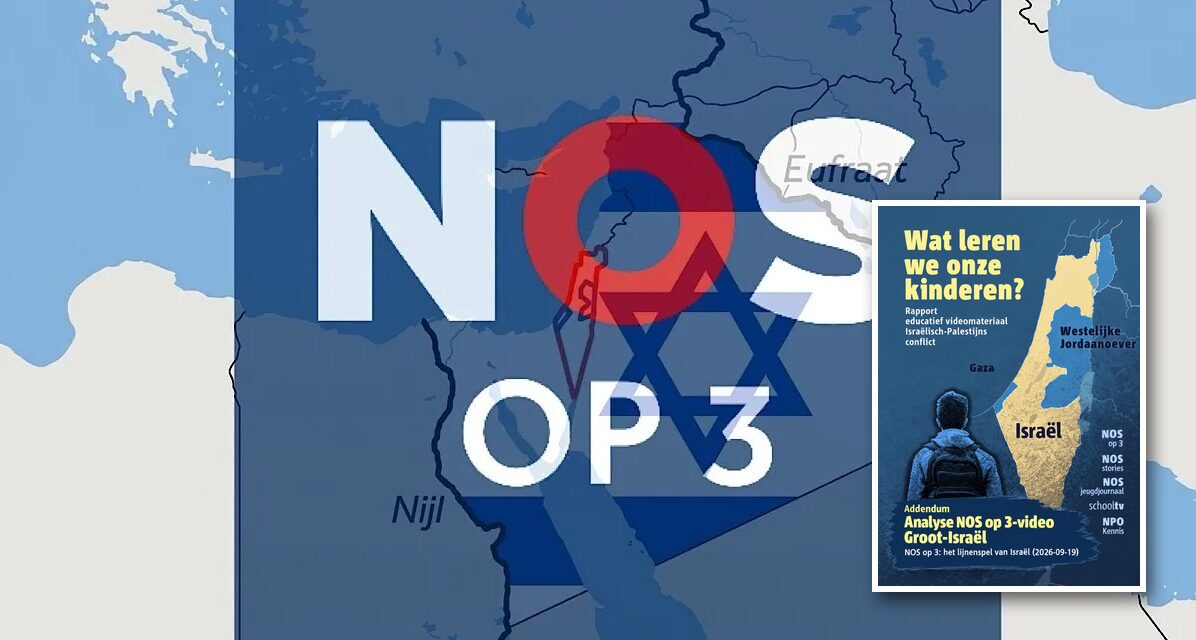
Last year we analysed dozens of videos to establish how the NPO (the Dutch public broadcasting organisation) informs Dutch young people about the Israeli-Palestinian conflict. We have now produced an analysis of a video from NOS op 3, the NOS’s channel for young audiences. We did this because, in this video, NOS op 3 crosses a new line.
With this video, the NOS (the Dutch public broadcaster) breaches its own journalistic standards, and is clearly not neutral, as also shown by its unchallenged footage of a Red Line demonstration with questionable slogans about genocide. The Dutch Media Act sets requirements for the NOS’s output. With this video, NOS op 3 fails to meet the legal requirement for balanced, pluriform and journalistically sound output, and so fails to meet the mandate of Article 2.1(2) of the Media Act. Moreover, this video does not meet the objectivity, diversity of opinion and diligence that the NOS itself says it strives for.
But worse is that, with this video, NOS op 3 is spreading an antisemitic conspiracy theory. The first quarter of an hour of the video is a long, politically coloured run-up in which plenty of journalistic norms are already broken. But from 17:47 onward, NOS op 3 presents the founder of Zionism — Theodor Herzl — as someone who sought a Greater Israel covering half the Middle East, from the Nile to the Euphrates. NOS op 3 further implies that hardliners in the Israeli cabinet are now pursuing this ideal. The map shown at 18:05 is not an Israeli policy document but a conspiracy map with an antisemitic history. This unfounded accusation of secret Jewish land-hunger fits seamlessly with old stories about malicious Jewish conspiracies to seize power.
That this video is aimed at teenagers and young people makes this even more reprehensible. It is precisely at this age that young people are vulnerable to influence, as we already explained last year in our report on the NOS and NTR videos. Almost every school in the Netherlands uses this video material, and media-literacy campaigns recommend it. If young people can no longer even trust this information, where are they supposed to find reliable information at all?
We hope the NPO will still adopt our recommendations from last year, which would prevent missteps like this video.
Below you will find the analysis of the video, following the same structure as the analyses in the report. First the video’s technical details, then a short summary. General observations on the content follow, and then a detailed analysis discussing the entire video minute by minute. Right at the end you will find a further explanation of the method we use to assess videos.
In the analysis below, text from the video is set in italics. Most of it is spoken by presenter Emil van Oers; this is sometimes noted for clarity. Where video fragments involve quotations, we use double quotation marks. The most common flaws are set in bold in the text. In one place (19:43), bold is used to show which words NOS op 3 cut from a quotation; this is also noted there.
José Hak & Maaike van Charante
19 September 2026 — NOS op 3: Israel’s Line Game
Link to the YouTube version:
https://www.youtube.com/watch?v=OjEvC9LRELE
running time: 20:20 minutes
468K views (site accessed 25 September 2026)
In short:
This entire video works towards making the conspiracy theory at the end credible: that Israel is an aggressive country that wants to conquer half the Middle East. There is no evidence whatsoever for this conspiracy theory — Greater Israel — so NOS op 3 can only make it seem plausible by:
- omitting relevant information
- suggestive language
- inaccurate information
- not showing differing viewpoints
- and a great deal of cutting and splicing in interviews
In the long analysis below — the video runs for 20:20 minutes — we show point by point where it goes wrong, and we provide sources in case readers lack the necessary background. People can hold differing views on this conflict, but a conversation on this topic is only possible if everyone involved bases it on the facts, and not on half-truths or even untruths.
General observations:
- Throughout the story, NOS op 3 ignores the terrorism Israel has faced for decades. The countless attacks by the PLO, the bloody intifadas, the rockets fired by Hezbollah and Hamas, the suicide bombings — none of it seems to exist. But by leaving this out, Israel’s responses appear to have no trigger: Israel becomes the aggressor.
- NOS op 3 also ignores Israel’s motives: bringing the hostages home, making sure Hamas can never carry out another 7 October attack, and stopping Hezbollah’s rocket fire. These are not mere claims — they are official war aims.
- Nowhere does NOS op 3 mention that Lebanon has had enough of Hezbollah and is seeking rapprochement with Israel. The majority of Lebanese want Hezbollah to disarm.
- There is a great deal of cutting and splicing in the interviews, making statements sound more extreme or more suspicious than they are. The video also gives extensive airtime to Israel’s most prominent extremists, as if they were representative of Israel as a whole.
- The history of peace negotiations, in which Israel was consistently willing to trade land for peace, only comes up in this video when the negotiations were successful. Every instance in which Israel’s willingness to make concessions ran into Arab and Palestinian refusal did not make it into the video — even though this very willingness on Israel’s part proves that Israelis are not pursuing a Greater Israel.
- Lastly: let’s also take a look at the Palestinians’ own line game. There is, among Palestinians, only a single map of any future Palestine. That map hangs everywhere Palestinians have self-government: in government buildings, in schools, in restaurants and in people’s homes. It is the ‘From the River to the Sea’ map. Fatah, Hamas, Hezbollah and Iran all promote this map, on which Israel does not exist. This map also appears in Palestinian/UNRWA schoolbooks, so that Palestinian children learn that Israel is not meant to exist. Anyone troubled by Israel’s ‘line game’ might want to think about this one too.
Analysis:
First, the title. ‘Israel’s Line Game’ suggests that Israel alone decides where the borders lie, as though other parties play no part in these conflicts. This is suggestive language.
(00:26) Presenter Emil van Oers: So there’s the Purple Line with Syria and the Blue Line with Lebanon. Both recently crossed by Israel. Suggestive language and omitting relevant information. This immediately frames Israel as the aggressor, while Israel crossed the border in response to aggression from others. Hezbollah attacked Israel from Lebanon (see also later in this analysis). When the Assad regime fell in Syria, Israel made sure dangerous weapons did not fall into the hands of extremists. Syrian Druze also called on Israel for help. Israel gave the Druze weapons, which later also proved badly needed.
(00:32) English-language fragment, subtitled: Israeli troops have entered a UN buffer zone. Suggestive language and omitting relevant information. The suggestion is that Israel broke international law by entering a UN zone. Information left out: in 2006, Hezbollah attacked Israel, and after a month of war a ceasefire followed, its main conditions being that Israel would withdraw and that Hezbollah would no longer have any military presence in southern Lebanon (UN Resolution 1701). The UN was to guarantee this, and Israel withdrew. Under the UN’s watchful eye, Hezbollah nonetheless built up a powerful military force there.
(00:37) English-language fragment, subtitled: The Israeli army has begun its invasion of southern Lebanon. Omitting relevant information. Hezbollah started a war with Israel right after 7 October (as NOS op 3 itself notes at 08:39), and only after eleven months (after many civilian deaths) did Israel strike back. It has been at war ever since. So it is not the case that Israel simply marched into Lebanon in March 2026 out of nowhere.
In these first fragments, the image of Israel as aggressor has already been set up. This is now the lens through which teenagers and young people — NOS op 3’s audience — will watch the rest of this video.
(00:41) And between Israel and the Palestinian territories runs the so-called Green Line, or… …used to run. Suggestive footage. Throughout this section, and the two English-language fragments that follow, the footage constantly shows tanks, rubble, explosions, barbed wire and — in the last case — bulldozers. Machines of destruction, and the only people shown are frightened victims of this violence. In this footage, Israel is not a country or a people; it is a war machine.
(00:50) English-language fragment, subtitled: “We’re looking for the Green Line. Do you know where the Green Line is?” “It doesn’t exist.” “It doesn’t exist?” No differing viewpoints shown. This is an interview with an Israeli extremist. Moderate Israelis do not appear on screen, even though the extremists are a minority. Incidentally, the emphasis on the Green Line in this video is misplaced. The Green Line was never a definitive border — it was an armistice line from 1949.
(00:55) Because both on the West Bank… English-language fragment, subtitled: Israeli settlers storm into the village (footage of men running across a field). … as in Gaza… (footage of military equipment at a border crossing) … the green disappears. Suggestive footage and omitting relevant information. Once again, hammering home that Israel is the aggressor, without showing a shred of the aggression directed at Israel.
(01:03) With a Yellow Line in Gaza now. English-language fragment, subtitled: Marking the edge of Israel’s expanding military zone (footage of yellow-painted concrete blocks marking the Yellow Line) Anyone who dares cross it can be shot. Emil van Oers: By now even an orange one. English-language fragment, subtitled (footage of Palestinian boys in a half-destroyed house): An even smaller piece of land. Suggestive language and omitting relevant information. Constantly portraying Israel as a menacing aggressor, and providing no information at all about the aggression from Hamas, which still refuses to disarm despite the agreements made in 2025.
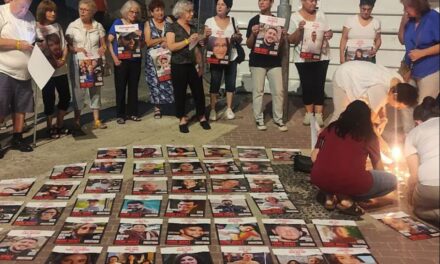
(01:18) And there’s a Red Line. Symbolic, then. (footage of a Red Line demonstration). Suggestive footage, and yes, blatant activism. One of the banners in shot reads: Genocide Holocaust in Gaza. Another reads: Stop genocide. For the record: no genocide has been established in Gaza. Only ideologically driven organisations and activists claim otherwise, and to do so they have to distort the facts. Colombia has recently withdrawn from the genocide case against Israel, South Africa has asked for a postponement, and countless experts have thoroughly and convincingly refuted any claim of genocide. By showing this demonstration without adding any critical remarks, NOS op 3 is choosing activism.
(01:24) Israel says it is safeguarding its own security. English-language fragment, subtitled (Netanyahu with two journalists): “Israel is defending itself.” (footage of rockets from Gaza) Emil van Oers: Rockets are being fired at Israel. (Israeli woman) “They just want to kill Israelis and Jews.” (Netanyahu) “What would you do?” Presenter Emil van Oers, meaningfully: Or is there more to it? This ten-second snippet apparently represents the Israeli perspective, immediately followed by suggestive language from the presenter. The moment there’s a hint of something viewers might sympathise with Israel over, it’s followed by an insinuation, and NOS op 3 immediately cuts to extremists pursuing Greater Israel.
(01:35) English-language fragment, subtitled (the same Israeli extremist as before): “God gave us Israel. The whole area.” (extremist Daniella Weiss on screen with a map showing Israel covering large parts of the Middle East) “I always carry these maps with me. This is God’s promise to the patriarchs of the Jewish nation.” Suggestive footage and omitting relevant information. This footage suggests that this thinking is widespread in Israel. NOS op 3 leaves out that this is such an extreme view that not a single party in the Knesset has it in its political programme. Not even the extremists Smotrich and Ben Gvir: at most, they want to annex Gaza and the West Bank. That doesn’t mean they don’t enjoy provoking. Smotrich, for instance, once gave a speech at a commemoration with a flag hanging over his lectern depicting a version of Greater Israel.
This was the introduction to the NOS op 3 video; now comes the main story.
(02:10) That year, they promise the Jewish people a national home. Within these lines. Of the British Mandate for Palestine. Inaccurate information and omitting relevant information. The map of the British Mandate is wrong. All of Jordan still belonged to it: that only split off in 1921/1922 and was then called Transjordan. The video also leaves out that Jews had always lived in the land.
(02:19) A movement that mainly gets going after the genocide of Jews in Europe during the Second World War (Holocaust footage). Inaccurate information and omitting relevant information. What movement is NOS op 3 even talking about? It appears to mean Zionism, which was already getting under way at the end of the nineteenth century, after the mass murders (pogroms) of Eastern European and Russian Jews.
(02:50) Arab countries reject the plan, because the twice as many Arabs as Jews within those lines get less than half the territory. Inaccurate information and omitting relevant information. Arab leaders did not reject this plan because they wanted a better division — they did not want a Jewish state at all. A quote from the statement by Palestinian leaders in 1948: “The Arabs of Palestine consider that any attempt by the Jews or any power group of powers to establish a Jewish state in Arab territory is an act of aggression which will be resisted in self-defense.” Other Arab leaders promised war and even genocide. Incidentally, the Jews were in the majority in the areas allotted to them. And the Jews mostly got poor land: marshland they had drained themselves, and the almost uninhabited Negev desert.
(02:59) The Jews celebrate. The Arabs are furious. It erupts into civil war. Omitting relevant information. NOS op 3 does not name the aggressor. The Arab population attacked the Jews in November 1947, immediately after the UN adopted the Partition Plan. The Jews defended themselves against this.
(03:20) The Palestinians call it the Nakba, the catastrophe. Many are killed. English-language fragment, subtitled: More than 700,000 Palestinians are driven out, their houses and land seized (1948 footage). Emil van Oers: …and flee. English-language fragment, subtitled: To escape the violence. Van Oers: …to Gaza, Jordan, Syria and Lebanon. Inaccurate information and omitting relevant information. This text suggests all 700,000 of those Palestinians were driven out, but that was only true for some of them. Most fled from the violence of war, in which calls by Arab leaders for their armies to have a clear run also played a part. Some ignored pleas from Jews to stay. Those who did stay became Israeli citizens. That is why more than two million Israeli Arabs now live in Israel: 21 per cent of the population. NOS op 3 also leaves out that not a single Jew was allowed to remain living in the Arab-controlled territories: those areas were completely ethnically cleansed. This included cities where Jews had lived continuously for centuries. The old Jewish quarter of Jerusalem was likewise ethnically cleansed, its synagogues almost all destroyed, and its graves desecrated.
On a positive note, NOS op 3 has already mentioned several facts that are usually left out of videos like this:
- The Arab armies attacked Israel in 1948. There was even a list shown on screen: Egypt, Syria, Transjordan, Lebanon, Iraq, Saudi Arabia and North Yemen all attacked Israel.
- Judea, Samaria and the Gaza Strip did not become a Palestinian state in 1948: Egypt occupied Gaza, and Jordan annexed Judea and Samaria and called it the West Bank. That is where the name comes from.
- The neighbouring Arab states refused to recognise the Jewish state.
(04:19) The same Israeli extremist appears again. English-language fragment, subtitled: “Has the Green Line ever existed?” “No.” No differing viewpoints shown.
(04:26) This remains the case until war breaks out again in 1967. Israel takes friend and Arab foe by surprise — a foe that had believed itself superior but was forced to swallow a humiliation (Six-Day War footage). Omitting relevant information. Israel attacked to prevent its own destruction. Egyptian President Nasser and other Arab leaders had been boasting for months that they were going to wipe Israel off the map, and Nasser then had the UN troops withdrawn from the Sinai desert. Those troops were there to keep Egypt and Israel apart, but the moment Egypt wanted them gone so it could attack, they left immediately. Egypt closed the sea route to the Israeli port of Eilat, and Israel then attacked. So Israel was not the aggressor: Prime Minister Levi Eshkol hesitated for a long time before he was persuaded to approve this pre-emptive strike.
(04:46) Israel occupies East Jerusalem and the rest of the Palestinian territories, Sinai in Egypt and the Golan Heights in Syria. Let’s zoom in for a moment. This highly strategic area, up to this demarcation line, is named: the Purple Line. The Golan Heights give Israel a superior military vantage point and a crucial security buffer in the Middle East. Omitting relevant information. Before Israel captured this ‘superior military vantage point’, it was in Syrian hands. And Syria did not use it as a vantage point but as a launch pad, which left northern Israel under constant fire.
(05:14) Israel uses its strong position to begin building settlements in the occupied territories, for Jews to live in. Illegal, under international law. Omitting relevant information. Right after the 1967 war, Israel hoped to be able to trade land for peace. The Arab states, including Egypt, refused. In August 1967, meeting in Khartoum (Sudan), they settled on the notorious three noes: no to peace with Israel, no to negotiations with Israel, and no to recognition of Israel. Only after this triple no did the residents of the kibbutzim of Gush Etzion, driven out in 1948, return.
Judea and Samaria have always been Jewish, and Jews have also lived in Gaza throughout the centuries. But when these areas — and the old Jewish quarter of Jerusalem — were ethnically cleansed in 1948, the rest of the world did not go and tell Jordan and Egypt that this violated international law. Now that the Jews were coming back, it was suddenly against international law for them to live in their old territories again. Here, the right of the strongest — the large bloc opposed to Israel — is being declared international law. The selectivity of this interpretation of international law also shows in the strong arguments of legal scholars who say the settlements are not illegal.
On a positive note, NOS op 3 clearly states that the neighbouring states attacked Israel in 1973. Israel was not the aggressor.
(05:46) Peace even follows. When Israel then leaves Sinai again, Egypt is the first to recognise the state of Israel. Years later, Jordan does the same. So, two official state borders. Omitting relevant information. This was land for peace, which Israel had wanted since 1967 but which the Arab states had rejected with their triple no at Khartoum. Israel proved it was genuinely willing to trade land for peace in 1979, through this very peace treaty with Egypt.
(06:29) The fall of Syrian President Assad. Syria in chaos. Israel seizes the opportunity to strike. On the ground too. Deeper into Syria. And higher, to the top of Mount Hermon. The highest mountain in the region. Which gives them an enormous strategic military advantage. And not only regarding Syria. With an eye on Lebanon too. That other neighbour to the north. Suggestive language and omitting relevant information. ‘Israel seizes the opportunity to strike’ suggests Israel was lying in wait and quickly grabbed some land. That ignores Israel’s security concerns. Syria was in complete turmoil, and whoever seized power there could well have turned out worse than Assad. Iran, moreover, exploited the cover of Mount Hermon to send drones towards Israel. The loaded little phrase ‘with an eye on Lebanon too’ likewise suggests aggressive intentions on Israel’s part.
(07:24) Until the Lebanese civil war. English-language fragment, subtitled: Sectarian violence between Christians and Muslims. Emil van Oers: Including Palestinians in southern Lebanon. When they also attack northern Israel, Israel crosses the Green Line here too for the first time. On a positive note, NOS op 3 does say that Palestinians attacked Israel from Lebanon, and that Israel responded. Omitting relevant information: the Palestinians — the PLO under Arafat — had earlier caused a civil war in Jordan and been expelled from that country. That is how they ended up in Lebanon.
(07:59) And in the year 2000, Hezbollah drives them entirely out of the country. Then the UN draws a new demarcation line: the Blue Line. Inaccurate information and omitting relevant information. Hezbollah did not drive Israel out; Israel withdrew unilaterally because the Barak government no longer saw a need to remain in Lebanon. Hezbollah, incidentally, ‘rewarded’ this later that same year by kidnapping and murdering three Israeli soldiers. The UN reported that Hezbollah violated the Blue Line multiple times, already in 2000, after the Israeli withdrawal.
(08:16) It escalates again in 2006. Omitting relevant information. None of the attacks by Hezbollah over the years are mentioned. And yes, Israel responded in 2006, though a ceasefire (UN Resolution 1701) followed that Hezbollah did not keep.
(08:39) On 8 October, Hezbollah declares war on Israel. English-language fragment, subtitled: Every day they fire drones and rockets at northern Israel. Emil van Oers: And then a great deal happens. Israel deals Hezbollah blow after blow in Lebanon. And also begins a ground invasion once more. Omitting relevant information. There was enormous chaos and panic in Israel after Hamas’s attack on 7 October 2023. This would have been a fine opportunity for NOS op 3 to say: ‘On 8 October, Hezbollah seizes the opportunity to strike.’ Hezbollah, incidentally, bombed northern Israel for eleven months before Israel truly struck back. Dozens of civilians were killed, large nature reserves went up in flames, and tens of thousands of Israelis had to flee. Israel did try to hit Hezbollah (mainly its launch sites), but it was only after the Hezbollah rocket that hit the Druze village of Majdal Shams — killing twelve children — that Israel truly attacked Hezbollah.
(09:02) A ceasefire then does follow, but… English-language fragment, subtitled (from 28 April 2026, a year and a half later): “Ceasefire isn’t exactly the word that comes to mind seeing this level of violence.” Suggestive language and suggestive footage. We see explosions and a reporter with a trembling voice, a year and a half after the ceasefire. None of this makes clear that Hezbollah only stopped its attacks after being decimated by Israel, and that there was no real surrender involved. That is why the fighting continued.
(09:11) And Israel has designated a no-go area. This area, where Israel has now drawn a Yellow Line. English-language fragment, subtitled (footage of children in Lebanon): People in these areas are being forced to leave on Israeli orders. Anyone who stays risks death. Suggestive language and omitting relevant information. Words like ‘forced’, ‘Israeli orders’ and ‘risks death’ suggest ruthlessness on Israel’s part, whereas this is actually about protecting civilians. Or should the Lebanese serve as a human shield for Hezbollah?
(09:25) Dutch-language fragment with Daisy Mohr: “Chaos, panic, despair, exhaustion.” Emil van Oers: And it doesn’t stop there. English-language fragment, subtitled (Minister Smotrich on screen): The far-right Israeli finance minister says the Litani River should become the new Israeli border with Lebanon. Omitting relevant information. Smotrich is an extremist whose party is probably not going to clear the electoral threshold, which is why he’s hoping for an alliance with another fringe party and makes extreme statements. This is not a widely shared view in Israel.
(09:38) A Yellow Line, forced evacuations — might remind you of something. English-language fragment, subtitled (Minister Katz on screen, voice-over narrating): Israel says it wants to do the same in southern Lebanon as it did in the Gaza Strip. Emil van Oers: And is threatening to raze it to the ground. Inaccurate information and omitting relevant information. This bit makes clear just how deeply the propaganda about a genocide in Gaza has already taken hold. The comparison with Gaza is enough to suggest a genocide will take place ‘in southern Lebanon too’. In fact, Katz did not say Israel wants to commit genocide in southern Lebanon and push the border forward to the Litani River. He wants to demolish buildings close to the border so Hezbollah cannot use them as cover, and he wants Israeli oversight of the area south of the Litani River. That is the area where the UN has, since 2006 — in breach of UN Resolution 1701 — allowed Hezbollah to build up a large attack force, so Israel has good reasons for this.
(10:11) English-language fragment, subtitled (interview with an Israeli passer-by): “Does the Green Line still mean anything to you?” “It doesn’t mean anything anymore. It’s rubbish. (Hebrew word) That’s bullshit in English.” Emil van Oers: But it’s still there on every map, forming the outline of the Palestinian territories. And forming the basis for a… English-language fragment, subtitled, in which UN Secretary-General Guterres and former President Joe Biden say: a two-state solution. King Charles: In Israel and Palestine. Guterres: There is no plan B. Omitting relevant information. The Arabs, and later the Palestinians, rejected a Palestinian state in 1937 (the Peel Plan), 1947 (the UN Partition Plan), 1967 (Khartoum), 1978 (Camp David), 2000 (Camp David), 2001 (Taba), 2008 (Olmert), 2014 (Kerry) and 2020 (Trump). Why? Because they do not accept a Jewish state alongside them. Incidentally, after twenty years of rockets from Gaza and the 7 October 2023 attack, most Israelis no longer want a two-state solution either. The murders of peace activists in particular were a heavy blow to the Israeli peace movement.
(10:39) The first Israelis came to these areas out of pure religious conviction right after the Six-Day War, says this settler, also here from day one. English-language fragment from 1972, subtitled: “These are the first places named in the Bible where the children of Israel settled. We therefore felt it was a logical choice to come and live here too.” Emil van Oers: What began with a few thousand is now some 750,000 settlers living in the occupied territory, spread across all these illegal settlements. Suggestive language, inaccurate information, not showing differing viewpoints, and once again omitting relevant information. As already reported (at 05:14), the first Jews returned to their old homes after the Arab states had said no three times at Khartoum. So the 1972 footage is not about those first Jewish residents after 1967, as NOS op 3 claims. Furthermore, Israelis came to live here over the years for various reasons, including religious conviction. NOS op 3 doesn’t show these differing views here, and uses suggestive terms such as ‘purely religious’, ‘settler’, ‘occupied territory’ and ‘illegal settlements’, which conjure up the image that every Jewish resident of this area is a religious fanatic and an illegal occupier. It also remains remarkable that so many people believe not a single Jew should be allowed to live in the area, while those same people find it entirely normal that millions of Arabs live in Israel. But no: Jews in Judea and Samaria — the old Jewish land where Jews had always lived until 1948 — apparently count as ‘illegal settlers’.
(11:14) Israel built this separation wall. Sometimes along the Green Line, but far more often beyond it too. As here, around East Jerusalem. Omitting relevant information. Israel began building the security fence (the great majority of it is a fence, not a wall) in 2002, during the Second Intifada. According to Israeli figures, more than 1,600 people were killed in attacks from the West Bank between September 2000 and 2006. After the barrier was built, the number of attacks fell sharply.
(11:27) Only here do the Palestinians still have complete control. Suggestive language. This sounds as though the Palestinians used to be in charge everywhere, when in fact they have never had a state of their own. The self-government in Gaza and the Area A parts of the West Bank is the most autonomy Palestinians have ever had.
(11:31) The rest of the area is under Israeli control. With an extensive road network of its own. Built by and mainly for Israelis. Three million Palestinians cannot move freely and everywhere in the West Bank have to pass Israeli military checkpoints. Omitting relevant information and suggestive language. The phrase ‘extensive road network of its own’ is a gross exaggeration. Yes, Israelis can move around more easily, but all over the West Bank the roads cross one another, are sometimes shared, and sometimes have gates or detours. In the past, there were no restrictions on freedom, but due to Palestinian attacks (especially during the Intifadas), Israel introduced ever more security measures. Hence, too, those checkpoints. Incidentally, Israeli civilians are, for their own safety, also barred from large parts of the area.
(11:49) Human rights organisations speak of an apartheid regime. With the Palestinians, especially since 7 October, increasingly cornered. English-language fragment, subtitled (BBC): Settlers are driving Palestinians off their land. These are the tactics settlers use to take over the land field by field. Presenting non-neutral organisations as neutral. Human rights organisations have stretched the definition of apartheid to make Israel fit it. The BBC’s anti-Israel bias has been demonstrated on multiple occasions. That is not to say there are no real problems, and there certainly are Israelis in the West Bank who misbehave. But that too is heavily exaggerated.
(12:05) And then there’s this controversial building project too… English-language fragment, subtitled: For its 1,200 homes for settlers in the so-called E1 area east of Jerusalem. Emil van Oers: …which cuts the West Bank in two for the Palestinians. English-language fragment, subtitled (UN spokesperson): That is an existential threat to the two-state solution. Omitting relevant information and suggestive language. There is no question of this E1 plan cutting the West Bank in two — it is a small area that Palestinians can easily go around. It is also strange for the UN to claim this building plan poses such a threat to the two-state solution. The area lies in Area C, the part of the West Bank under Israeli administration, and under several peace proposals E1 would become part of Israel.
(12:23) Then Gaza. Back to the Green Line again. Here too, since the 1960s, Jewish settlements and Palestinian uprisings. Omitting relevant information. Until 1948, there were Jews living in Gaza, and Jews had also lived there in earlier centuries.
(12:36) the rise of Hamas. English-language fragment, subtitled (Hamas footage): …that wants to establish an Islamic state in place of Israel. Emil van Oers: …which then says it is out to destroy the state of Israel. And wants to achieve that goal through terror. English-language fragment, subtitled (2001, after the Tel Aviv bombing): Many people here are demanding a forceful response to the deadliest Palestinian attack in the country in years. Concealing terrorism. Van Oers says of Hamas that it ‘says it is out to destroy the state of Israel’. That is not an empty claim — it is a fixed aim of Hamas, stated in their charter, reaffirmed in countless speeches, and proven time and again through their actions.
(13:11) In 2005, Israel even withdraws from Gaza. English-language fragment, subtitled: To make things safer for Israelis and reduce tensions between them and the Palestinians. Israel says this means the end of the settlements in Gaza (footage of Jewish residents of Gaza being removed) with relocation within the Green Line. Emil van Oers: Gaza was meant to become a free Palestinian enclave. With the Green Line as its border. Omitting relevant information. NOS op 3 doesn’t mention that all 21 Jewish settlements in Gaza were forcibly cleared by the Israeli army: 8,500 residents were removed from their homes and lost their businesses and land. This contradicts this video’s narrative — that Israel only ever wants to expand — and is precisely why it is relevant.
What follows now is a long section of footage describing the situation after 2007. Here, NOS op 3 suggests a sequence of events that is not correct.
(13:31) But… English-language fragment, subtitled: Little has changed; the Oslo Accords delivered little. Emil van Oers: Because Gaza isn’t free. As occupier, Israel remains in charge of Gaza’s airspace, sea and borders. Including the one with Egypt. English-language fragment, subtitled: Israel and Egypt have imposed an economic blockade on Gaza. Gaza is sealed off. Most Palestinians don’t speak of Gaza as their home, but as a huge prison, built and guarded by Israel. (13:56) Van Oers: Instead of… English-language fragment, subtitled: …hope for peace between Israelis and Palestinians… Van Oers: …it has only escalated further. Arabic-language fragment, subtitled (footage of a crowd of angry, uniformed and flag-waving terrorists): We will make the earth tremble beneath your feet, by the will of Allah! English-language fragment, subtitled: Hamas steps up its attacks on Israel. Despite bombardment by tanks and F-16s. (14:02) Van Oers: Israel tightens its grip. English-language fragment, subtitled: According to many Palestinians, the solution begins with an end to the Israeli occupation.
Only then, at 14:21, comes: Hamas grows, wins elections. Only after that does the story of Hamas’s violent 2007 power grab and its terror campaign from Gaza finally follow. Inaccurate information and omitting relevant information. This sequence has been reversed. Gaza was given a golden opportunity to show that Palestinians could govern themselves peacefully — think, too, of the greenhouses and infrastructure Israel left behind (soon afterwards destroyed by Gazans), and the generous financial support from countless countries and organisations. It was only after Hamas turned Gaza into a terror base and relentlessly attacked Israel with rockets and kidnappings that Israel began strictly guarding the border. By reversing this sequence, NOS op 3 suggests that Hamas’s violence was a reaction to Israeli oppression, but it is exactly the other way round. Just as Hezbollah did in 2000, Hamas in 2005 saw Israel’s withdrawal as a sign of weakness, and attacked.
After this, the story jumps straight to 7 October 2023, since NOS op 3 apparently doesn’t find those tens of thousands of rockets fired from Gaza at Israel relevant. Footage from that day follows, and then Emil van Oers continues (14:57): That day, Hamas kills 1,200 people in Israel, mostly civilians. Israel is merciless. Suggestive language. Van Oers passes a moral judgement on Israel (‘merciless’); on Hamas, we get only the dry facts.
(15:09) Footage of explosions and rubble. Emil van Oers: It literally flattens Gaza. Footage of rubble and crying children. Emil van Oers: And starves the civilian population. English-language fragment (BBC), subtitled: It is committing genocide, crimes against humanity and war crimes, according to UN rapporteurs. Unproven accusations, inaccurate information and omitting relevant information.
- The rubble has to do with how Hamas fights. The enormous damage comes from blowing up tunnels and blowing up houses that Hamas has booby-trapped. On top of that there are also falling rockets (roughly 10 per cent of the terror rockets fall back on Gaza), as well as Israeli tank shells and bombs. Here are more details from a military expert.
- The hunger in Gaza has been enormously exaggerated in ideologically driven reports and by circulating images of sick children. Time and again, claimed famines turned out not to have existed, though there really were local shortages, mainly due to Hamas’s mafia-style practices. More details here.
- And then there’s the genocide claim. Every organisation or expert proclaiming genocide has used the same recipe: stretch the definition, ignore counter-evidence, fabricate supporting evidence. What’s more, there is growing evidence undermining earlier genocide claims.
- Lastly, on those UN rapporteurs: here NOS op 3 presumably means the statements of the controversial Francesca Albanese and her colleagues, or the Human Rights Council’s ‘genocide report’. That report is riddled with inaccuracies and omissions. The most bizarre omission: Hamas’s tunnels do not feature in it at all. For more details, see this thorough analysis.
(15:25) That’s where this symbolic Red Line comes into it. English-language fragment (Al Jazeera), subtitled (footage from the Netherlands, genocide banners): A Red Line against Israel’s genocide in Gaza. Omitting relevant information and unreliable sources. Al Jazeera is an ideologically slanted broadcaster with sympathy for Hamas and the Muslim Brotherhood, and a strong aversion to Israel. But the NOS often uses Al Jazeera material. This video was made with NOS journalists David Poort and Lennard Swolfs, both of whom have worked for Al Jazeera.
(15:48) A year ago, Israel draws the Yellow Line here, occupying more than half of Gaza with it. Omitting relevant information. At the moment Israel drew that line, there were still dozens of hostages in Gaza.
(16:02) On paper, this is a demarcation line. English-language fragment, subtitled: If Hamas lays down its weapons, Israel will withdraw its troops. Emil van Oers: But an agreed pause in the fighting doesn’t happen either. Dutch-language fragment with Nasrah Habiballah: “Israel doesn’t want to talk about a permanent end to the war for as long as Hamas remains in power in Gaza.” The English fragment does touch on Hamas having to disarm, but it isn’t given much emphasis, even though Israel has been in the dock for the whole video. A casual listener — the average teenager — will conclude that the fighting is mainly Israel’s doing. But Israel’s withdrawal and Hamas’s disarmament were linked in the ceasefire agreement. Israel will not withdraw if Hamas does not disarm; not while Hamas leaders have sworn to repeat 7 October until there is no Israel left. The footage of fighting still going on in Gaza suggests one-sided aggression by Israel, but has to be seen in this context.
(17:06) This is how Israel sees it. English-language fragment, subtitled (Netanyahu): “Israel is defending itself. It’s fighting radical Islam, which threatens the future of the world.” Emil van Oers: A fight that has escalated along every line since 7 October 2023. In Syria, Lebanon, the West Bank and Gaza. With more and more territory under Israeli control. Suggestive language and suggestive footage. After all the accusations in this video, Netanyahu’s statement sounds implausible — especially since it is immediately followed by yet more footage of tanks, rubble and the border lines, every shift of which is blamed on Israel.
(17:28) And that line game still isn’t over. Beyond these two official state borders, that is. A meaningful look from Van Oers: Or is it? English-language fragment, subtitled (street interview with an extremist): God gave us Israel. The whole area. Literally, he says: “All of it.” Van Oers: But the question is: what is ‘all of it’? Because there’s also such a thing as Greater Israel. Suggestive language. Van Oers is constantly suggesting Israel has hidden motives. The idea of Greater Israel mainly exists among extremists such as Daniella Weiss. In Israel, it’s considered so extreme that not a single party with any chance of a seat has it in its political programme. Not even Smotrich and Ben Gvir. At most, they want to annex Gaza and the West Bank, which is already considered fairly extreme in Israel.
From 17:47, NOS op 3 shifts entirely into conspiracy mode. Here is the text.
Because there’s also such a thing as Greater Israel. An ideal of the founder of Zionism, Theodor Herzl, already in the 19th century. Which he based on this Bible passage… (Genesis 15:18 on screen: “To your descendants I give this land, from the river of Egypt to the great river, the Euphrates”) …a land promised by God to the descendants of Abraham. What exactly a Greater Israel would look like is not known. But Herzl was talking about an area from the River Euphrates to the Nile.
Inaccurate information. That text from Genesis does indeed exist, but it is a religious text, not a Zionist party platform. Herzl — who, incidentally, was not religious — knew that text but did not use it as a guide. In chapter 4 of his book Der Judenstaat (1896), he named Palestine or Argentina as possible sites for a Jewish state — not exactly biblical. The 1897 Basel Congress wanted a ‘Heimstätte in Palästina’ (a home in Palestine), not one from the Nile to the Euphrates. Herzl negotiated over El-Arish (Sinai) and even considered Uganda. That is the opposite of a great biblical empire. That is not to say nothing at all was ever discussed in Zionist circles, but NOS op 3’s Greater Israel was never the official Zionist goal. Herzl accordingly never even asked the Sultan of the Ottoman Empire for that territory for a state. This conspiracy theory about an alleged Zionist longing for Greater Israel has been circulating for a long time, and Daniel Pipes already put it to rest back in 1994. Pipes also explained several relevant Bible passages (Numbers 34:1–12 and Ezekiel 47:13–20) which carry more weight in Jewish tradition and outline the borders of a much smaller Israel.
The map shown from 18:04 to 18:07 is therefore a conspiracy map. Misleading images.
There is, incidentally, another detailvisible on the map. In the bottom-left corner it reads: Middle East Political and Economic Institute (MEPEI). This institute organises conferences in cooperation with the Iranian regime, published a book together with the Iranian embassy, and passes on messages from the regime. This is, at the very least, evidence of warm ties with a regime that has been promoting the Greater Israel conspiracy theory ever since the 1979 Iranian revolution. A Tehran reprint (1985) of The Protocols of the Elders of Zion contained a map, ‘The Dream of Zionism’, which bears a striking resemblance to the map shown on NOS op 3.
The term unreliable sources is really too weak to capture what is going on here.
The Protocols of the Elders of Zion is the most notorious anti-Semitic book in the world. The Protocols revolve entirely around an alleged, malicious Jewish hunger for power, and the conspiracy theories surrounding it were used to justify pogroms, the Holocaust and other persecutions of Jews. The book is very popular in the Middle East.
On YouTube, the NOS thanks three NOS correspondents for proofreading the script and providing critical feedback. Daisy Mohr, David Poort and Lennard Swolfs know the Middle East well. The fact that this anti-Semitism did not catch their attention, or did not prompt them to intervene, raises the question of how the final editing process was handled.
(18:07) English-language fragment, subtitled (Tucker Carlson interviewing US Ambassador Mike Huckabee): “From the Euphrates to the Nile?” “That’s a God-given land to a people He chose.” Omitting relevant information. Huckabee’s remarks have been taken out of context. In that interview, a theological discussion and a conversation about modern politics were running together. Huckabee made clear during the interview itself that this is not what Israel is pursuing, and that the US doesn’t want this either. The full clip can be watched here.
(18:11) Something Zionist hardliners are still pursuing today. English-language fragment, subtitled (Daniella Weiss showing an extreme map): “This is God’s promise to the patriarchs of the Jewish nation.” “So this is biblical Israel? And what countries are these?” “Better not to say.” No differing viewpoints shown. NOS op 3 acts as if extremist Daniella Weiss is representative of Israel. This video lacks any Israelis who actually are representative.
(18:27) And those hardliners currently hold ministerial posts in Netanyahu’s cabinet… (footage of Ben Gvir and Smotrich) …openly talking about territorial expansion… English-language fragment, subtitled (Smotrich speech): “A political decision will come to extend our borders in Lebanon to the Litani River.” Omitting relevant information. Smotrich leads a fringe party; he will probably not clear the electoral threshold unless he forms an alliance. Leaving this out makes Smotrich seem more influential than he is.
(18:39) …and even about ethnic cleansing. English-language fragment, subtitled (Ben Gvir on a podcast, with a released hostage): “We need to take out 30 or 40 of them every night. Not just the ones posing a direct threat. There are people there who aren’t worth living. They’re not even human. I’m giving them a compliment by calling them human.” Omitting relevant information and inaccurate information. Ben Gvir’s remarks are reprehensible, but here he was talking about terrorists, not ethnic cleansing. He said, incidentally, in that same conversation that Netanyahu disagreed with him on this, so again this is selective cutting and splicing to make extremism in Israel look more influential than it is. More details on these remarks by Ben Gvir here — in Hebrew, unfortunately, but Google Translate is patient.
(18:55) And the Americans? Always been Israel’s most important ally. But what the US ambassador says here about Greater Israel… English-language fragment, subtitled (Huckabee with Carlson again): “Does Israel have a right to that land? You are, after all, referring to Genesis.” “It would be fine if they took the whole thing.” Emil van Oers: …was, until recently, unthinkable. Once again, omitting relevant information. This comes from the same interview as the earlier fragment. In that interview, a theological discussion and a conversation about modern politics were running together, and NOS op 3’s cutting and splicing strips the statements of their context. As already noted, Huckabee made clear during the interview itself that this is not what Israel is pursuing, and that the US doesn’t want it either. The full clip can be watched here.
(19:13) Netanyahu himself also let slip in this interview that he embraces the vision of Greater Israel. The host shows him a pendant here. The cameras can’t see what it is. And then the interviewer asks… English-language fragment, subtitled: “Do you agree with this vision?” “Absolutely.” “Really?” “Certainly.” “This is Greater Israel.” Emil van Oers: The conversation moves quickly on, and Netanyahu then says he is on a historic mission. Omitting relevant information. NOS op 3 gives the worst possible reading of this moment here. The pendant Netanyahu was presumably given can look like a map of present-day Israel if you glance at it quickly. NOS op 3, moreover, cuts off Netanyahu’s answer. When the interviewer said, ‘This is Greater Israel,’ Netanyahu replied: ‘If you ask me, we’re there.’ You can even see this briefly on screen: ‘If you ask me, we’re there.’ He presumably meant present-day Israel by this. It’s conceivable that Netanyahu secretly wants to conquer half the Middle East, but if this is the best ‘evidence’ NOS op 3 can find for it, it isn’t convincing.
(19:38) (footage of a map where an Israeli flag covers half the Middle East) For Zionist hardliners, Greater Israel is the ultimate goal. However many suggestive shots and interviewed extremists NOS op 3 wheels out, this is not Israeli policy, and it has no support among the population.
(19:43) For now, the line game is playing out around the borders with Syria, Lebanon and the Palestinian territories. About which Netanyahu says… English-language fragment, subtitled: “The Jews belong to this land, this land belongs to the Jews. It’s our land, not your land. It’s been our land for 3,500 years.” Suggestive language: ‘For now’ suggests Israel is going to cross even more borders later. Inaccurate information and omitting relevant information. Netanyahu did not say this about Syria and Lebanon. The clip comes from an interview with Jordan Peterson in which Netanyahu gives a slanted version of history, but certainly does not argue for the conquest of Syria or Lebanon, or for ethnic cleansing. Here are the pieces NOS op 3 cut, in context. What the NOS cut is shown in bold. Note that Netanyahu explicitly says the Jews want to live together with the Palestinians — something NOS op 3 cuts out. The clips appear in the order NOS op 3 used, which is not chronological.
(5:45) ‘You have no right to be there, but the Arabs who are trying to destroy you, they have that right.’ That is a complete perversion of history, and also a complete perversion of justice. (5:55) The Jews belong to this land, this land belongs to the Jews. The Palestinians are free to live here next to us, among us, but they’re not free to demand the dissolution of the Jewish state.
(4:13) We decided to establish a state in 1948, that’s 75 years ago, and we said: ‘Everybody can live here.’ The Arabs said: ‘There can’t be a Jewish State, you have no right to be here. It’s our land.’ It’s not your land! It’s been our land for 3,500 years. if you took over somebody’s apartment, knock them out, dispossessed them, and they never gave up the claim and they said: ‘It’s our claim!’ And you left this barren dump… okay? And the families, the progeny of the people you kicked out came back, rebuilt the house. You cannot come back and tell them: you don’t belong here.
(20:05) So we know where Israel begins. Or rather, when. English-language fragment, subtitled: The new state of Israel. Emil van Oers: But where this line game ends… nobody knows. Misleading footage and suggestive language. With this piece of film, NOS op 3 suggests Israel began in 1948, which grossly misrepresents the centuries-long connection of Jews to this land, and their permanent Jewish habitation of it throughout the ages. Most countries in the world are younger than Israel. They gained their sovereignty through decolonisation. The same is true of Israel. Beyond that, that closing sentence lays on, thick and unmistakable, the suggestion that ‘Israel’s line game’ will only end once ‘Greater Israel’ has been achieved. Anyone who has read this far knows this is a baseless insinuation.
Explanation of our assessment method
This was the method for our report, and we have applied it again here to this video.
We assess the content against the Code of Journalistic Conduct (2023), which offers plenty of purchase on most points, and fall back on the older Journalistic Code (2016) for points no longer included in the new code but that matter precisely because this is educational content. Where necessary, we draw on points from other journalistic codes. Because this is educational content, we also apply the standards that apply to educational material.
On 13 November 2025, a new Code of Journalistic Conduct was published, but it differs only in details from the 2023 code.
Applying these criteria to the NPO’s material for young people produced the list below of the most common flaws:
- Omitting relevant information
- Inaccurate information
- Not showing differing viewpoints
- Unreliable sources
- Biased/suggestive language
- Unproven accusations
- Presenting non-neutral organisations/people as neutral
- Misleading footage
- Concealing terrorism
The description below comes from our report and applies to this analysis too.
In the analyses, we have indicated whenever we spotted these flaws, and for clarity we have set the terms from this list in bold within the analyses.
Because the videos differ greatly in length, presentation and subject matter, the analyses also differ in length and in the level of detail covered. To still give a quick impression of each video, a very short summary of the main issues we found appears at the start of every analysis. Each analysis also includes a link to the video, so you can watch the material for yourself.
The titles of the analyses give the date on which the material was published. Directly beneath the links to the videos, you will find the video’s running time and its number of views (as far as we could establish this), which gives an impression of how widely this material has spread. Finally, text from the videos is shown in italics, and statements by people in the videos are sometimes given quotation marks for clarity.