Anyone who googles ‘hunger as a weapon’ finds countless news articles and videos about Gaza. Most Dutch people have heard it said at some point that Israel has deliberately created a famine in Gaza, and even if not everyone believes it, the constantly repeated message still has an effect. More and more Dutch people think it is true. But this famine exists mainly in the propaganda war against Israel.
A new report has been released, this time from UNICEF, and it shows that the food situation in Gaza is currently good. There is no famine. In fact, the situation is better than before the war. The food situation in Gaza is, incidentally, also better than in Jordan, Syria or Egypt; hunger is now as uncommon in Gaza as it is in Western Europe.
Crisis in 2024
Finally! you will say. Finally the misery has turned around, finally deliverance has come for the starving children of Gaza! After all, there has been a terrible famine in the region in recent years, hasn’t there? Dutch schoolchildren can still watch a video on NOS op 3 (the Dutch public broadcaster’s youth channel) or Schooltv (a Dutch educational broadcaster) titled ‘How Gaza Is Dying of Hunger’.
That video, from March 2024, confronted schoolchildren with emaciated children. It was based on a troubling IPC (Integrated Food Security Phase Classification) report, from which NOS journalists quoted with concern. Unfortunately, those journalists failed to mention that Israel had fiercely criticised that report, and that the criticism turned out to be justified. In June 2024, the IPC’s own oversight body acknowledged that the report had not been accurate.
And those emaciated children? Yazan al-Kafarneh became famous as the face of hunger in Gaza, but weeks before the NOS released this clip, it was already known that he suffered from cerebral palsy, which meant he could not eat normally. Fadi Al-Zant, the other thin boy, had cystic fibrosis.
Alright. Time to fact-check this story.
You have probably seen images of this Gazan child shared widely, accompanied by the claim that "Israel is systematically starving children to death" and that the child looks like this because there is no food left. That's false.
The… pic.twitter.com/c8IHd5UCu3
— Ridvan Aydemir | Apostate Prophet (@ApostateProphet) March 2, 2024
Their physical decline did indeed have something to do with the war, because these vulnerable children needed special care. That care was disrupted by the war. Fortunately, Fadi could be evacuated in time, but for Yazan, help came too late.
Their suffering deserved attention. What these children did not deserve was to have their suffering used to suggest that everyone in Gaza was starving.
Establishing a Famine
And it did not end with the outcry in March 2024. Later that year, the IPC sounded the alarm again, and in 2025 a famine was declared in Gaza, which the media reported on extensively. Even in 2026, alarming reports were still appearing. The NOS incidentally cited Médecins Sans Frontières — which no longer operates in Gaza — as a source. But was there ever a famine in Gaza?
To assess that, it is important first to understand how these reports come about.
The IPC reports our media cite come from various aid organisations. These organisations sometimes publish separate reports of their own, but the joint IPC reports they issue are considered especially authoritative. When they sound the alarm about (impending) famine, the IPC Famine Review Committee (FRC) assesses whether famine is indeed occurring. Sometimes, as in June 2024, this oversight body decides the situation is less severe than initially claimed.
In principle, these organisations adhere to officially established standards. Before a situation can be classified as a famine, 20 per cent of households must face severe food shortages, 30 per cent of children must be acutely malnourished, and a certain number of people must be dying of hunger: two per 10,000 residents and/or four per 10,000 children.
None of these thresholds has ever been met in Gaza. In July 2025 it was claimed that they had been met, but independent researchers discovered that the IPC report was riddled with problems. The authors had adjusted percentages, relaxed measurement methods, and predicted death tolls (10,143) of which Hamas’s Ministry of Health confirmed only a fraction (192) — and even those cases were not beyond dispute.
🚨Final Gaza fake “famine” analysis: IPC declared famine on Aug 22. Through ceasefire on Oct 10 there should have been 10,000 starvation deaths. But Hamas/UN counted 192 (most if not all with pre-existing conditions). That's 98% below famine levels. It was always a hoax. 1/ pic.twitter.com/jWcZOnwdAe
— Aizenberg (@Aizenberg55) October 21, 2025
Reliable Sources
The bizarre thing is that IPC reports on other regions are generally very reliable. It is only when it comes to the Palestinian territories that they play fast and loose with the figures. It has long been clear that many organisations represented in the IPC — Oxfam, Save the Children, numerous UN bodies — harbour no love for Israel, but manipulating the figures is a step further still.
And yet these organisations do exactly that, and many media outlets pass on their reports uncritically. By now, these media organisations should know that these bodies are not neutral when it comes to Israel, yet they keep pretending they are reliable sources. In July 2024, for instance, the NOS quoted Pim Kraan, the director of Save the Children, on the situation in Gaza. Kraan said: ‘There is large-scale famine.’
The NOS added no caveats to this statement, and asked no critical questions. This despite the fact that the very same NOS had, just over a month earlier, reported on the FRC’s own finding that — despite the earlier outcry — there was no famine. Pro-Israel organisations such as UK Lawyers for Israel are left doing journalists’ work for them, checking IPC reports and publishing the FRC’s corrections.
And the NOS is not alone in this blind trust in NGOs. Pieter Klok — editor-in-chief of de Volkskrant (a leading Dutch newspaper) — claimed on the talk show Eva Jinek that international aid organisations are reliable sources, because ’they don’t do propaganda’. Media that handle partisan sources this way are choosing to become a link in the anti-Israel propaganda chain.
The Propaganda Chain
It ought to be common knowledge that these organisations declare Israel guilty from the outset. In October 2025, Michel Thieren — a representative of the World Health Organization (WHO) — revealed that some organisations had already been discussing, as early as 2023, how to accuse Israel of causing famine in Gaza. He even said they took pleasure in it.
The eagerness with which prominent figures claimed a (looming) famine sometimes took absurd forms. UN representative Tom Fletcher, for instance, claimed in May 2025 that 14,000 babies in Gaza would die within the next 48 hours unless additional aid arrived. It was a bizarre claim, but media around the world published it. NOS and NRC (the Dutch public broadcaster and a leading Dutch newspaper, respectively) fell for it too.
Viral claim:
14,000 babies could die in next 48 hours.
Reality:
– IPCC found 14100 young kids (not babies) could face malnutrition (not death) over the next year (not 48 hours) IF conditions don’t improve.
Also, the photo being used is from Yemen.
Just lie after lie. And… pic.twitter.com/EgC3prgLV0
— AG (@AGHamilton29) May 21, 2025
Aid organisations and UN spokespeople regularly make grotesque accusations against Israel that, on closer inspection, turn out to be untrue, but this does not make the media any more cautious. They often go a step further still, publishing photographs of emaciated children as ‘proof’ of famine — children who, it later emerged, were often thin because of various illnesses.
The Price of False Alarm
All these false accusations demonise Israel. But they also make Israelis cynical. Why would you still believe the NGOs when they cry hunger in Gaza for the umpteenth time? As a result, a genuine food crisis in 2025 was only recognised once Yannay Spitzer, an assistant professor at the Hebrew University, raised the alarm.
Spitzer analysed food prices in Gaza and realised, in June 2025, that Gaza really was on the brink of famine this time — even as Hamas’s own warehouses were still full. Fortunately, Israeli journalists took his warning seriously and gave it wide coverage. Under pressure from public opinion, the Israeli government acted and stepped up food aid in time.
On that occasion, people in Gaza began to go hungry due to faltering food aid, and there will undoubtedly also have been local food shortages caused by the constant evacuations. But a famine is something quite different from occasional local shortages. And a major problem is that many media outlets and aid organisations exaggerate the suffering — and, moreover, blame Israel for it exclusively.
Ignoring Hamas
It is not realistic, during a war, to hold only one party responsible for the suffering of civilians. And yet both the media and the aid organisations prefer to look away from Hamas’s role in the food situation in Gaza. A good example is the coverage by the NOS of the floating pier built by the US off the coast of Gaza in 2024, intended for delivering aid supplies.
The NOS reported regularly on this pier. Not enough aid could be delivered this way; the delivery of aid was not going smoothly; Palestinians in Gaza said it made no difference; the pier had been damaged by storm; the project had failed… But nowhere did the NOS report the fact that Hamas bombed the pier.
The same went for the well-documented theft of aid supplies by Hamas. Countless clips have been posted on social media by Gazans themselves, showing markets in Gaza where food aid — not meant for sale! — was on offer. There are videos of terrorists stealing food aid, and the UN itself stated in August 2025 that two-thirds of the aid entering Gaza was being stolen.
Last month, a senior UN official published a statement about the ongoing sabotage of food supplies by ‘armed individuals’. Even this statement omits the name ‘Hamas’, although everyone knows who was meant by the ‘de facto authorities’. But these crimes by Hamas receive little or no attention from the so-called quality press.
When the Media Stop Doing Their Job
Anyone who reviews the history of these accusations of hunger in Gaza sees the same pattern again and again. Aid organisations and UN committees make wild accusations that often turn out, in hindsight, not to hold up. This is not exposed by critical media, but by Israeli researchers or pro-Israel organisations who are themselves regarded as partisan.
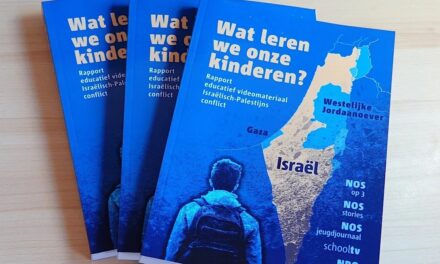
The Hebrew University, for instance, examined food aid in the first half of 2024 and concluded that more than enough food was getting in. CIDI (the Dutch Centre for Information and Documentation Israel) has demonstrated that the reporting on the number of trucks delivering aid before the war was inaccurate, and even brought a lawsuit over this against the NOS. We, too, wrote a report on the educational videos the NOS produces. On pages 81 and 139 of our report, you can find the analyses of the videos about hunger in Gaza.
But the media do not thank researchers for being forced to do their job for them. They distrust these sources and prefer to ignore them. Apparently they would rather confirm their prejudices than seek out the facts. That is how ‘hunger as a weapon’ could become a standard accusation against Israel. And when these media accuse Israel, they would do better to look in the mirror.
‘Hunger as a weapon’ is itself a weapon in the propaganda war against Israel.
This article was originally published in Dutch.
Update 12 August: The second link in this article, under the word ‘UNICEF’, now leads to a form where people must request access. The data is thus no longer publicly available.
If anybody still needed convincing that the whole “famine” narrative was one huge, shameless fabrication, the UN has just provided yet another proof – by blocking access to the recently released malnutrition data that exposed their fraud. https://t.co/hDfGpLCHK7
— Mark Zlochin – מארק זלוצ'ין༝ (@MarkZlochin) August 12, 2026
Update 13 August: Many more reports had been made inaccessible, but it seems it eventually dawned on them that this wasn’t such a wise move from a public relations perspective. The reports are accessible again.
Ok, they have restored the links to the reports repository that had previously been removed from the Nutrition Cluster website and reopened public access to the files.
Seems like they eventually realised that making the files disappear was a pretty bad look. https://t.co/c7P5TT3qAh
— Mark Zlochin – מארק זלוצ'ין༝ (@MarkZlochin) August 12, 2026
You can support the work of Maaike van Charante at repelsteeltje.backme.org
Want to stay up to date with new articles and podcasts? Follow Maaike on Twitter.