Sylvain Ephimenco was a lone voice at Trouw (the Dutch daily that traces its origins to the wartime resistance press). Now even this dissenting voice is gone — and what happened is characteristic of many Dutch newspapers. On contentious subjects, they enforce a dominant narrative that tolerates no challenge. In doing so, they seal themselves inside a bubble from which reality recedes ever further. The demonisation of Israel is perhaps the most glaring consequence of this radicalisation.
Until February 2011, my husband and I subscribed to NRC (the Dutch broadsheet NRC Handelsblad). We had our criticisms of the paper, but the opinion pages were a breath of fresh air. Sharp minds aired their often opposing views there, and for us, that diversity alone made the paper’s motto credible: slijpsteen voor de geest — whetstone for the mind.
One by one, the contrarian thinkers disappeared from NRC, and in 2010 the motto became Ik denk… NRC — “I think… NRC.” That felt, to us, rather too much like “the paper will tell you what to think.” When in 2011 the last dissident — Afshin Ellian — was shown the door, we left too. We had no interest in having our opinions pre-digested for us; we hungered for debate.
This passage from Ellian’s farewell column spoke for me precisely: “I thought I fitted perfectly at a liberal newspaper. But I have the impression that sharp criticism and dissent are experienced as ballast. Among pages full of politically correct stories about the gentle side of Islam, multiculturalism, and the welfare state, my difficult, rather critical voice for freedom is seen as too provocative.”
John Stuart Mill
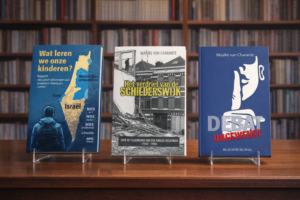
As the British philosopher John Stuart Mill made clear in his essay On Liberty, dissent is not a luxury — it is a necessity. In my second book, Debat ongewenst (Debate Unwelcome), I placed this quotation from On Liberty at the front:
“Not the violent conflict between parts of the truth, but the quiet suppression of half of it, is the formidable evil: there is always hope when people are forced to listen to both sides; it is when they attend only to one that errors harden into prejudices, and truth itself ceases to have the effect of truth, by being exaggerated into falsehood.”
Dutch editors-in-chief should (re)read John Stuart Mill. It is not vigorous debate that is dangerous — it is the absence of debate that is dangerous. Whoever silences dissent paves the road to radicalisation. A bubble may feel comfortable at first, but such a sealed-off world drifts inevitably away from reality, and ends up as a sectarian breeding ground for prejudice.
Happy birthday, John Stuart Mill! Here are Mill's three main arguments for freedom of speech, from "All Minus One: John Stuart Mill's Ideas on Free Speech Illustrated." Download a free copy here: https://t.co/c6QV4vPffS HT @JonHaidt @HdxAcademy pic.twitter.com/SuWztd6VF5
— Steve Stewart-Williams (@SteveStuWill) May 20, 2020
Token dissidents
Dutch newspapers that present themselves as intellectually serious often do recognise, somewhere, that dissent is necessary. Amid all the ideological uniformity, there was always a resident columnist who struck a different note. I used to call these people, somewhat sarcastically, token dissidents — because genuine counter-argument elsewhere in those papers was usually nowhere to be found.
At de Volkskrant (the Dutch centre-left daily), Martin Sommer served long as the resident token dissident, and I held my breath when he left. But credit where it is due: de Volkskrant appointed new dissidents. Jolande Withuis still challenges sacred cows there on a weekly basis. Even NRC has not entirely calcified, thanks to occasionally fine columns from writers such as Rosanne Hertzberger and Aylin Bilic.
And yet a totalitarian wind is blowing through the Dutch media landscape — one that grows ever less tolerant of dissenting voices. In June 2025, Theodor Holman was pushed out of Het Parool after more than 30 years. He concluded himself that this was probably connected to his position on Israel — because Holman dared to have doubts, and on Israel, doubt is no longer permitted.
Ephimenco
It was no accident that Sylvain Ephimenco, Trouw’s token dissident, used his final column to draw attention to a recent front page that dripped with Israel-hatred. He wrote: “The regrettable front-page photograph on Tuesday, in which an armed Israeli soldier plants the Israeli flag in a dish of hummus, is one example of this. When reporting becomes ideological or takes on obsessive forms — my words — this is a problem.”
Elsewhere in the column, he described the restrictions the editors-in-chief had sought to impose on him: “With this new column, I would have to steer clear of current affairs and the polemic that comes with it, with a first review after three months and a decision after a year on whether the column would continue.” In other words: the dissident was placed under supervision — though the respectable Trouw would never use the word censorship.
Ooit had elke krant zijn excuusdissident: blijkbaar is zelfs dat voor @trouw anno 2026 nog te veel gevraagd.
Verbijsterend dat een krant DIT👇 eist van een gerenommeerde columnist.
Beter dat #Ephimenco de eer aan zichzelf hield.https://t.co/sDfy4jXj2F pic.twitter.com/LA4dxS2db7— Maaike van Charante (@Repelsteeltje21) May 23, 2026
Translation tweet: Every paper used to have its token dissident. Apparently, in 2026, even that is too much to ask of @trouw. Staggering that a newspaper demands THIS👇 of an established columnist. Better that #Ephimenco kept his dignity. https://t.co/sDfy4jXj2F
It is painful to read back how the resistance paper spoke of its own name, Trouw, in 1943.
“Trouw en waarheid zijn nauw met elkaar verbonden. Trouw ziet op het handelen, waarheid op het spreken. Wie waar is in zijn spreken, is tevens trouw in zijn daad.”
“loyalty and truth are closely bound. Loyalty concerns one’s actions, truth one’s words. Anyone who speaks the truth is also loyal in their actions.”
This paper has shown truth the door, and has, logically enough, proven faithless.
Just as with Holman, it appears that Ephimenco’s heresy — his refusal to go along with the paper’s Israel-hatred — cost him his place. He was justifiably critical of Israel, but he would not follow his newspaper into its anti-Israel obsession. The implication of that front-page photograph — that Israel had somehow “colonised” the dish of hummus — was merely the latest in a long line of such moments. Trouw, the former resistance newspaper, has long since made its choice.
Facts
Not that Trouw ultimately pressured Ephimenco out because of his nuance on Israel alone. There was another pretext to hand. Ephimenco had written a column about three major shortages facing the Netherlands. Clean drinking water can no longer be taken for granted; neither can access to the electricity grid. The housing shortage, too, is dire.
Ephimenco named the elephant in the room: “What links those three shortfalls is population growth: the Netherlands already has, after Malta, the highest population density in Europe (approximately 500 inhabitants per square kilometre). (…) Population growth in the Netherlands in recent years is entirely attributable to migration.”
Trouw responded by publishing angry letters about the column, followed by an editorial. That editorial proceeded as though Ephimenco had identified immigration as the sole cause of these shortages (he had said it was the common factor), and then declared that his column was not supported by verifiable facts.
This from a paper that publishes weekly columns by Jamal Ouariachi. His February column on Gaza was riddled with defamatory claims unsupported by any verifiable facts. But of course. That column dripped with Israel-hatred — and when it comes to Israel, Trouw abandoned the path of verifiable facts long ago.
Anti-Israel
I will not soon forget the fact-free editorial that appeared after the Colonna Report on UNRWA was published. The editors had apparently not bothered to acquaint themselves with its contents, and proceeded to brand Israel a liar. This was never corrected. Even in the piece in which Trouw was forced to acknowledge that Israel had been right, the paper still managed to imply otherwise. For the facts, I refer you to my piece on the subject, in which Catherine Colonna herself was given the floor.
Trouw has excelled in anti-Israel coverage for years. A recent example is a “question to readers” that is decidedly not grounded in verifiable facts. “Would it help the safety of Jewish Dutch citizens if the Netherlands were to distance itself politically from Israel? Has ’the Flotilla’ been the final straw?” A selection of reader responses is due to appear on Wednesday, 27 May.
Opinion editor Laura van Baars supplies “facts” to prime the readers. According to her, Gaza is suffering from hunger due to a lack of aid supplies, and Israel has committed genocide in Gaza. Both claims are demonstrably false. Ample food is entering Gaza — though Hamas obstructs fair distribution — and genocide is genuinely something other than what has been and is happening in Gaza.
The significance of this is far bigger than some people may realise. Karim Khan is an ideological loyalist. He wasted little time trying to file charges against the Israeli leadership after the events of October 7th, when the war in Gaza broke out. Sure, he also put out arrest… https://t.co/V8zWS8QscB
— Aɴᴛ (@AntSpeaks) May 8, 2026
But what do facts matter when accusations fit so neatly into the prejudices of the Trouw editorial board? It feeds its readers a little more propaganda to generate toxic letters, then publishes those letters as “proof” that Israel is a rogue state. And the one columnist who occasionally still offered a dissenting note on all the demonisation of Israel — him they push out the door.
Israel is the canary in the coal mine
What is happening in the Dutch media right now goes far beyond activist reporting on one particular subject. It is true that coverage of Israel is demonstrably dishonest and demonising — but the same has been true for years of coverage of the United States, of Dutch farmers, of political parties, and of immigration. And that list is not exhaustive.
The disease afflicting the Dutch media stems from weaknesses in human nature — weaknesses that are amplified by the erosion of journalistic standards through postmodern relativism and Western self-loathing. If truth doesn’t exist, why bother searching for it? If evidence-free musing is worth as much as an opinion grounded in solid research, why go to the trouble of research at all?
All the papers named above cut corners on their own journalistic standards. And where quality control disappears, instinct fills the void. These papers love writing about the tribalism of the “populists” — yet they are at least as tribal themselves. They promote herd behaviour and despise any voice that breaks with it.
Under the banner of Israel criticism, they publish sensationalist articles that on closer inspection turn out to be built on nothing. But for genuine Israel criticism, they might take their cue from Israeli media, which erupted last week over the disgraceful conduct of minister Ben Gvir. And they might take to heart what Hen Mazzig writes here:
You insist that you aren't allowed to criticize Israel without being called antisemitic.
Right now, Israelis are tearing into Ben Gvir.
No one's calling us antisemites.
But when you criticize Israel, you deny it should exist. When we do, we demand it be better.
Get it?
— Hen Mazzig (@HenMazzig) May 20, 2026
Debate unwelcome
Nowhere is debate conducted more sharply than in Israel itself. But in the comfortable Netherlands, the media deliver ready-made opinions, and smother dissent. As minister Kajsa Ollongren once said, with evident alarm: “You can set people and groups against each other simply by giving both sides a hearing.” Anyone who thinks like that finds debate frightening, and obedience to the dominant narrative reassuringly safe.
Ephimenco’s departure from Trouw is not an isolated incident. It fits a timid zeitgeist. The core educational standards still specify that pupils must learn to think critically. In practice, critical thinking is treated as suspect — and dissidents are expected to keep quiet.
That is a slippery slope towards totalitarianism.
Update: following the publication of this article, Trouw has made significant changes to Laura van Baars’s reader’s question. In the original question, Van Baars drew a direct link between the safety of Dutch Jews and political action against Israel. Apparently, even Trouw felt this went too far. You can still read the old version of the piece here; this is the new version. The inaccuracies mentioned above are still present.
Translator’s note: Trouw (literally “loyal” or “faithful”) is a Dutch national daily newspaper founded in 1943 as an underground resistance paper during the Nazi occupation. Its name carried the explicit moral weight of loyalty to truth and freedom. Maaike van Charante’s title — “How the resistance disappeared from a dutch resistance newspaper” — plays on this founding identity.
You can support Maaike van Charante at repelsteeltje.backme.org
Want to stay up to date with new articles and podcasts? Follow Maaike on Twitter.