Much has already been said, written, and above all laughed about the woke Language Guide produced by the Dutch Ministry of Education, Culture and Science (OCW). Rightly so. Let us by all means make today’s moral crusaders so thoroughly ridiculous that every rebellious teenager will be embarrassed to take them seriously. Monstrosities like menskracht (human-power), basisgeletterd (basically literate), and homomannen (homosexual men) deserve mockery — followed by a quiet death. And that is before we even get to the sheer impracticality of what this guide is trying to achieve.
Contradictions
Take page 38 of the word list, where a cluster of recommendations combine to produce absurd results. This section covers terms relating to gender and LGBTQ+, the woke brigades’ favourite battleground. Here are three recommendations, side by side:
- Avoid gays; prefer: homosexual men
- Avoid men; prefer: transgender men, cisgender men
- Avoid homosexual men; prefer: men who have sex with men
On this single page, there are already multiple contradictions. One moment the guide recommends homosexual men; the next, it advises against it. The same goes for men — first discouraged, then used without comment. But suppose a diligent civil servant were to try applying all these recommendations at once. A description of gay men would come out as: Cisgender or transgender men who have sex with other cisgender or transgender men.
Personally, I suspect 99 per cent of gay men would rather just stay gay.
… and more contradictions
And speaking of contradictions: the guide is littered with recommendations that make language needlessly complicated. Say you want to write about a blind, Black slave from the Arab world who came to the Netherlands as a refugee and was lucky enough to find a man to marry. Following the guide’s advice, it would come out like this:
A man of colour who was enslaved, with a visual impairment, who due to his sexual orientation wishes to have sex with other cisgender or transgender men, fled from predominantly Arabic-speaking countries owing to dangerous conditions there, and arrived in the Netherlands where he was fortunate enough to find a cisgender man with whom he could enter into a same-sex marriage.
Still with me? Now bear in mind that elsewhere in the same guide, on page 7, there is a plea for accessible language. It reads: “Our advice is to write at B1 level wherever possible. B1 language is simple and clear, and therefore easier to understand for most people. This means using short sentences, choosing simple words, and writing actively rather than passively.” Simple and clear? Short sentences? The guide’s own recommendations are impossible to reconcile.
Nor do the authors show any capacity for self-reflection. Page 3 states: “This guide provides advice and guidelines on which words we use and why. It also teaches us more about the right tone and message for language use within OCW that is as inclusive as possible.” And yet on page 8 we read: “Take each other seriously (avoid tone policing). In a debate, conversation, or in the media, people are often attacked on tone rather than message or argument.” Apparently, not all tones are equal…
Woke Is Not Defeated
Everything about this language guide breathes woke. It shows in the complete absence of logic, the elevation of feelings over facts, the compulsive moralising, and the contempt for Western culture. It is no wonder that woke was quickly mocked and despised in recent years.
For a moment, it seemed as if woke was losing ground — as if common sense had prevailed. A hopeful column by Jolande Withuis — “if the signs are not deceiving us, woke is in retreat” — gave voice to that feeling. It appeared in de Volkskrant on 2 April. The very next day, the language guide leaked. How could we have thought things were getting better? Life is hard. It rarely gets easier.
Because this is not the only language guide. The City of Amsterdam produced one back in 2017. The national secondary school association LAKS followed in 2023, prompting parliamentary questions. It turns out there is also a Practical Guide to Inclusive Language and Conduct from the Cultural Heritage Agency, which also falls under the OCW ministry. All of it in the spirit of the National Action Plan for More Diversity and Inclusion in Higher Education and Research.
Who knows how many more of these guides are circulating. Woke is not defeated. Woke has embedded itself in our government institutions and is merrily gnawing away at the foundations of our society.
Sweet and Sly
Woke loves to complain about toxic masculinity. But this ideology displays every hallmark of toxic femininity. That particular combination of saccharine sweetness and quiet malice. Always talking about feelings, while knowing exactly where to place the knife. Mean girls excel at manipulation — and what is their weapon of choice? Language.
Read the OCW language guide carefully, and the sweetness falls away. You see the slyness beneath. It seems so considerate to replace Mother’s Day with You Day — for children without a mother — but is it really considerate to strip mothers of the word mother? It seems so thoughtful to sanitise traditional Sinterklaas songs — colonial associations, you understand — but is it thoughtful to further dismantle a much-loved tradition? And underneath all of it, of course, lies the hatred of the West and of the white man.
Orwell
Members of Parliament raised questions about the suddenly discovered language guide, and State Secretary Tielen of Education and Emancipation tried to play it down. Yes, the guide was a little paternalistic, but it was an internal matter for civil servants, and she did not want to interfere too much.
This in response to a contribution by Peter van Duijvenvoorde (FvD — Forum for Democracy) who identified the guide’s central premise: “…that language cannot always capture reality, but can construct it.” He asked the State Secretary whether she acknowledged that this guide aimed to shape reality — and on what basis the government considered itself entitled to make such language norms prescriptive.
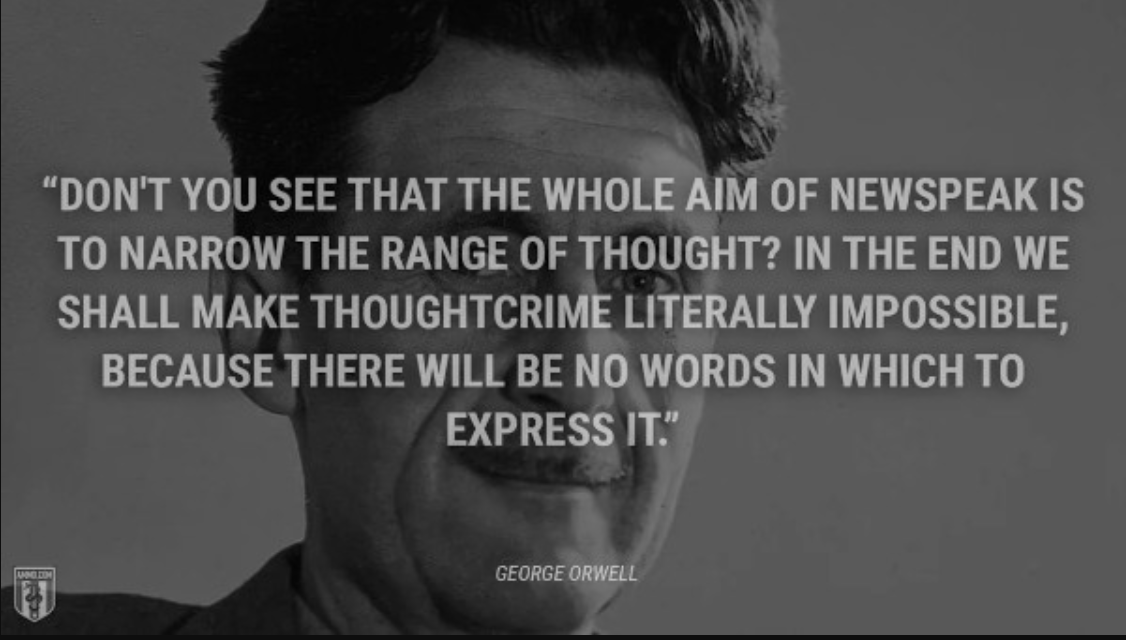
It was entirely appropriate that Mona Keijzer later cited George Orwell’s 1984 in her written parliamentary questions: “Don’t you see that the whole aim of Newspeak is to narrow the range of thought?” The passage continues: “In the end we shall make thoughtcrime literally impossible, because there will be no words in which to express it.” Language is a powerful weapon, because language shapes thought. We think in language, and for that we need words. The conversation these quotes come from concerns the new language — Newspeak — being developed in the novel. That language was steadily stripped back, to ensure people would have no words in which to express their thoughts.
Erasing words
Language is a powerful weapon, because language shapes thought. We think in language, and for that we need words. The conversation these quotes come from concerns the new language — Newspeak — being developed in the novel. That language was steadily stripped back, to ensure people would have no words in which to express their thoughts.
Making words disappear is not innocent. Words like father, mother, Golden Age, white [in the sense of Caucasian], Middle East — and even the Dutch word neger. These words carry deep meanings that connect us to each other and to our history. Words give us roots. And yes, this even applies to the word neger, which the language guide has declared so taboo that page 26 states: “We never reproduce the N-word, not even in a quote.”
For the record: the actual Dutch N-word was nikker, a slur. Neger was a neutral descriptive term, which activists have seized upon as evidence of discrimination. By making it taboo, these activists sever our ties with the past — including with the very archives that contain information about the issue they claim to care so much about: the history of slavery. Rendering history inaccessible fits seamlessly with the tactics of the Ministry of Truth that George Orwell wrote about.
Implications
For anyone who thinks nobody takes these language guidelines seriously: remember how leading Dutch media outlets — the NOS (the public broadcaster), NRC, de Volkskrant, Trouw, and RTL — replaced the Dutch term blank (fair-skinned) with wit (white). There were no good arguments for this change. The fear of being called racist was decisive. And this, incidentally, is yet another example of woke’s particular slyness: causing offence has been declared a mortal sin, but calling white people wit against their wishes — that is apparently “equitable.”
So what happens when governments, educational institutions, and organisations actually take these language guidelines seriously?
People become anxious and uncertain, because they cannot get it right. The rules contradict each other. On top of that, they are not allowed to use outdated terms — and what was acceptable yesterday (empower, identifies as) is wrong today. The language itself becomes unclear. Students no longer progress to a higher level; they switch schools. Because thinking in terms of levels is wrong — we are all equal, after all. “Everyone a professor!”
The guide is full of warnings against hierarchy, yet it is clearly working towards a new hierarchy of its own. Which is why Dutch and Western culture may not be portrayed positively. “We avoid language that makes the ‘West’ look better.” Which is why white people must henceforth accept being called wit. And do not underestimate the manipulation: those who do not comply are not simply dissenters. They are bad people. People who hurt others.
Revenue model
The authors of the language guide presumably do not grasp the damage they are doing by playing so carelessly with language. I was not surprised to discover that they are almost exclusively women. Take a look at the website of the Expertise Centre for Diversity Policy (ECHO), and search online for Ailing Eelman. These individuals presumably received the €40,000 that State Secretary Tielen mentioned — but it would be naive to think that was the full extent of the public money flowing in this direction.
The ECHO foundation held charitable status (ANBI) until October 2023, and its mandatory published annual report for 2022 makes clear that the OCW ministry — from which ECHO originally emerged — remains an important partner. The report also lists the municipalities of The Hague and Amsterdam. The word “subsidy” appears nowhere, and no amounts are mentioned. This non-profit organisation was not exactly forthcoming.
But apparently money is no object: ECHO funds a professorship in Education and Diversity at the Vrije Universiteit Amsterdam. As it happens, the same university where board member Vinod Subramaniam served as rector until 2021. Small world. The professorship is naturally held by a woke academic — Maurice Crul — who informed de Volkskrant that Dutch people without a migration background “had better learn to accept that they have lost their majority status in many cities.” His advice to them: integrate into the new diversity.
Diversity machine
Another surprise. The chair of ECHO’s board is former GroenLinks (Green-Left) MP Naima Azough. On the website of Colourful People, she describes how she has built an extensive and diverse network across government, education, culture, and the social sector. That checks out, given the string of positions she goes on to list — though the chairmanship of ECHO is not among them.
Anyone who reads through these connections can see how the diversity machine operates. It runs on marketing, networking, and knowing where the public money is. And above all: speaking the right language and spreading it further. Someone like Azough, who promotes “values-driven leadership, inclusion and equal opportunity,” naturally contributes far more to our society — in the woke worldview — than a simple farmer or lorry driver.
Parliament Must Act
Let us hope that Members of Parliament stay sharp when the answers to their questions arrive. Those questions could easily be forgotten, just like the motion passed by Martine van der Velde and Claudia van Zanten in November 2024. Do you remember what it said? “That the unnecessary replacement of specific terms such as ‘mother’ and ‘father’ with gender-neutral concepts can lead to confusion and can undermine the preservation of socially recognisable roles.”
It further called on the government “to retain terms such as ‘mother’ and ‘father’ in legislative texts.” The language guide is not a legislative text — but it is clear that a substantial parliamentary majority at the time had no appetite for casually erasing the words mother and father.
Would there be a parliamentary majority for funding Orwellian language guides? In any case, this is not something citizens can put the brakes on themselves. If the government keeps the diversity machine running, only Parliament can step in.
This article previously appeared in Wynia’s Week.
You can support Maaike van Charante at repelsteeltje.backme.org
Want to stay up to date with new articles and podcasts? Follow Maaike on Twitter.