This article was written for the Dutch-language anthology ‘Chronicle of Zionism’. For the online publication, the footnotes have been converted into hyperlinks; however, as virtually all of these links refer to Dutch-language sources, they have not been included in this English-language version. Anyone wishing to consult the sources can find them in the original article.
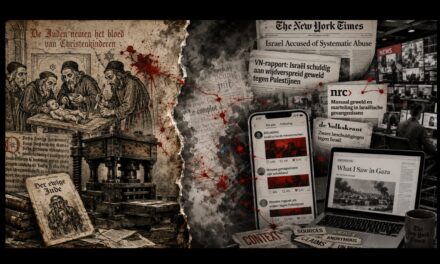
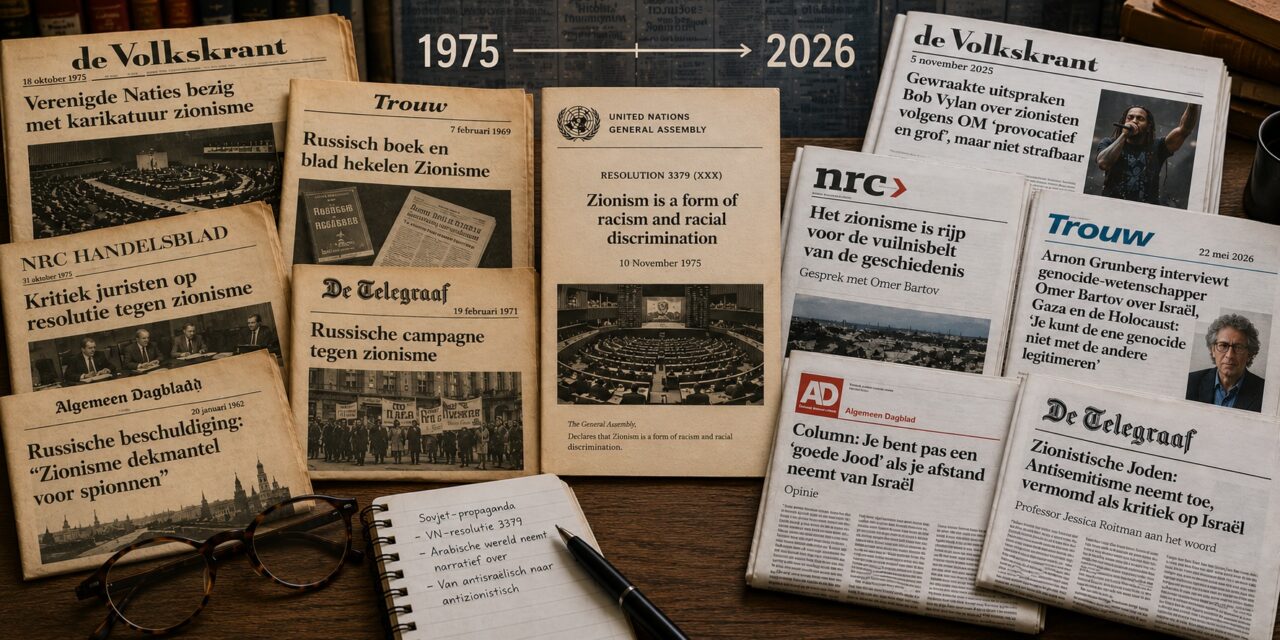
Open a Dutch newspaper today and you can read that Zionism is a colonial, even genocidal, ideology. ‘Zionism is ripe for the dustbin of history,’ NRC wrote, on the authority of Israeli historian Omer Bartov. In another NRC interview with this academic, Bartov was still gracious enough to concede that Zionism had once been a respectable ideology. NRC journalist Sjoerd de Jong added that Bartov was thereby conveying a message that ‘runs counter to the activist conventional wisdom that Zionism was racist and genocidal from the very beginning.’
De Volkskrant, too, publishes statements by anti-Zionist Jews. ‘Zionism is a system of Jewish supremacy in the land of the Palestinians,’ Jewish biologist Zyanya Breuer stated. Jewish writer Maurits de Bruijn was asked: ‘You call yourself an anti-Zionist; what does that mean to you?’ His answer: ‘That I oppose the racist, annexationist, violent and genocidal acts that Zionism is now leading to.’ The third national newspaper often counted among the Dutch quality newspapers is Trouw. This paper, too, makes room for anti-Zionist Jews, such as writer Arnon Grunberg, who was given the chance to interview (yet again) Omer Bartov. Oddly enough, though, there seems to be little interest in Zionist Jews. Are they now in the minority?
Pressure on Zionist Jews
In De Telegraaf, Zionist Jews are given a voice more often. Professor Jessica Roitman teaches Jewish Studies at the Vrije Universiteit (VU) Amsterdam. She calls herself an outspoken Zionist and argues that since 7 October 2023, antisemitism has been dressed up as criticism of Israel and of Zionism. In the AD, the fifth major national newspaper, Jewish columnist Kitty Herweijer wrote: ‘You’re only a ‘good Jew ‘ if you distance yourself from the state of Israel.’ That earned her a rebuke from a reader: ‘A good Jew does indeed distance himself from this bloodthirsty war government, as well as from the illegal settlements and the apartheid policy.’
In 2026, Jews are under pressure to distance themselves from Israel, and to condemn Zionism as a colonial ideology that led to the ‘historical mistake’ of founding the state of Israel, as Dutch historian Maarten van Rossem puts it. The big question, of course, is where this demand to distance oneself comes from. Has the state of Israel really degenerated into a rogue state? Is Zionism (or has it become) a racist and genocidal ideology? Such grave accusations deserve thorough investigation, and perhaps first and foremost into the origins of the accusations themselves. For when did the stories about Zionism as a colonial, racist ideology begin? To find out, we don’t even have to go back very far in history.
UN resolution against Zionism
A little over fifty years ago — on 10 November 1975 — the battle over the definition of Zionism reached a turning point. That day, the UN General Assembly adopted a resolution stating that Zionism is a form of racism and racial discrimination. The resolution was revoked in 1991, but it is interesting to look at how it came about, and at what Dutch newspapers wrote about it at the time.
By 1975, the Soviet Union and the Arab world had been campaigning against Israel for years. The Arabs initially did so mainly by waging wars, the Soviet Union through relentless propaganda about ‘imperialist and colonialist Zionism’. Over time, the Arab countries adopted the Kremlin’s narrative, but anyone who looks through the archives can see that the Soviet Union led the way. Through Delpher.nl — an invaluable online archive of Dutch newspapers — I found reports from the five largest Dutch national newspapers that accurately reflect this history.
The Soviet Union in 1948
Originally, the Kremlin looked favourably on the founding of the state of Israel. The Soviet Union was in fact the very first state to grant Israel full recognition as a sovereign state, although the Americans had already given provisional recognition earlier. A passage in Algemeen Handelsblad (a forerunner of NRC) on 18 May 1948 clearly illustrates the rivalry between Washington and Moscow:
‘It has become apparent in recent days that the American government is taking a relatively favourable attitude towards the Zionists, although there is as yet no question of lifting the arms embargo on the Middle East. Russia, too, did not hold back and, according to A.P., outdid the United States by recognising the new Jewish state without the reservation of a ‘de facto ‘ recognition, as America had done.’
Soviet propaganda against Israel
Only after ties between Israel and the US grew closer did the Soviet Union begin to regard the Jewish state as an adversary. Fittingly, the first Russian accusation about Zionism I found in Delpher was typical of the Cold War: the Russians claimed that Zionism was a cover for spies (AD 1962).
The second report illustrated the formation of the Soviet-Arab bloc against the Western-Israeli bloc, and the first attempts at diplomatic warfare through the UN. The Soviet Union had tabled an amendment at the UN putting Zionism on a par with antisemitism and Nazism (De Telegraaf 1965). That attempt failed — for now — but the propaganda continued. Zionism was supposedly an invention of the Jewish bourgeoisie, which was said to be the partner of reactionary imperialism (Trouw 1969).
The Russian accusations soon shifted to unadulterated antisemitism and demonisation. ‘The arch-enemy of the Soviet Union is not the United States of America or the People’s Republic of China, but a mysterious monstrous alliance of criminal Jews, referred to as the international Zionist concern.’ (Trouw 1971). Zionism had allegedly allied itself with Nazism and even collaborated in the extermination of the Jews (de Volkskrant 1970).
Dutch newspapers wrote with revulsion about the Soviet campaign against Israel and against Zionism.
Soviet-Arab alliance
From the late 1960s onwards, reports appeared of Arab leaders adopting Soviet rhetoric. The newly founded PLO (Palestine Liberation Organisation) led the way. ‘Zionism employs the methods and pursues the aims of imperialism,’ proclaimed Mahmoud Hamshari (Trouw 1969), then the PLO’s spokesman in France. At the time, PLO terror dominated the front pages: aircraft hijackings, bombings of aircraft that killed countless people, terror attacks around the world, the attack on the Munich Olympics, and the unleashing of a bloody civil war in Jordan.
Despite — or thanks to — this terror campaign, the Soviet-Arab alliance scored successes at the UN: in 1974, PLO leader Yasser Arafat was allowed to address the UN General Assembly. ‘Dressed in his military uniform (the outline of a pistol in his trouser pocket clearly visible) and wearing his black-and-white chequered headdress, Arafat spoke for eighty minutes in Arabic. (…) ‘I have come,’ he said, ‘bearing an olive branch and a freedom fighter’s gun. Do not let the olive branch fall from my hand.’’ (AD 1974).
The Netherlands stood behind Israel
In November 1975, the UN resolution declaring Zionism a form of racism and racial discrimination was adopted. The vast majority of the Dutch House of Representatives strongly condemned the resolution, but the radical-left CPN (Communist Party of the Netherlands) and PSP (Pacifist Socialist Party) — which later merged into GroenLinks (GreenLeft) — stayed on the sidelines. The foreign affairs spokesman of the VVD (People’s Party for Freedom and Democracy) said the UN had sunk into a deep swamp, and Relus ter Beek of the PvdA (Labour Party) proposed attaching conditions to Dutch participation in UN activities (AD 1975).
Ahead of the vote, NRC wrote of ‘a stunt by the Arabs’, and warned that the UN General Assembly was setting out on a ‘perilous path’. The paper reported on the opposition to this from the US and the Western European countries, and wrote: ‘That is the only possible stance towards this development, to prevent the justified struggle against racial inequality from being misused as a political weapon of highly dubious character. Hopefully, this time, unlike in Mexico, the Dutch will see that too.’
Why that reference to Mexico?
The Netherlands did not stand behind Israel
The UN resolution of November 1975 was not the first attempt that year to brand Zionism as racism. From 19 June to 2 July 1975, Mexico City hosted the UN World Conference of the International Women’s Year. On the last day of the conference, the ‘Declaration of Mexico’ was put to the vote and adopted. Among other things, the declaration stated that besides (neo)colonialism, racism, apartheid and imperialism, Zionism too had to be ‘eliminated’ (De Telegraaf 1975).
‘That ‘Declaration of Mexico ‘ had been submitted by the 77 developing countries: the ‘Third World ‘. Most EEC countries abstained; the United States, Israel and Denmark voted against. One EEC country voted in favour… the Netherlands’ (De Telegraaf 1975). There was widespread outrage in the Netherlands, and prominent Dutch figures wrote a letter to ministers Van der Stoel, Van Doorn and Pronk, who had instructed the delegation to vote this way (De Telegraaf 1975).
Foreign Minister Van der Stoel (PvdA) had to account for himself in the House of Representatives. Answering parliamentary questions from MPs Wiegel (VVD), Franssen (PvdA), Kleisterlee (RVP), Van Dam (ARP), Kruisinga (CHU) and Drees (DS’70), the minister said he did not believe Dutch support for the declaration had further isolated Israel (Trouw 1975). Moreover, for the Netherlands, the rest of the declaration’s content outweighed the objection to endorsing a condemnation of Zionism (De Telegraaf 1975).
This answer met with widespread disapproval, and at the next attempt to brand Zionism as racism — the resolution in the General Assembly — the Netherlands did vote against.
Propaganda then and now
So what has changed in the past fifty years? There were failings in Israel back then too, and Dutch newspapers wrote about them, but without lapsing into the sanctimonious outrage that now sets the tone. The big difference between then and now is not that the news was different, or that the accusations were. The same charges were levelled back then: colonialism, apartheid and racism, comparisons with the Nazis, and conspiracy theories about the secret power of Jews behind the scenes.
The big difference is this: back then, the establishment still saw through it. Today, a large part of the establishment goes along with it. What was once radical left is now mainstream. Perhaps this is because in the 1970s it was still so obvious that this was Soviet propaganda, whereas the same accusations now come from NGOs and even from the UN.
Shifts at the UN
The reservations Dutch politicians had about the UN in 1975 showed a clear grasp of the new balance of power. Western countries, used in the colonial era to their norms and values setting the standard, discovered that decolonisation in many cases also meant a departure from those norms and values. Authoritarian states soon formed the majority at the UN, and they often regarded human rights not as a core value but as a political weapon, useful primarily against the West.
Dutch politicians of the time saw the dangers of these changes. Dutch politicians of 2026 invoke the authority of the UN as though the General Assembly consisted of respectable democracies jointly representing an unassailable body of international law.
Even then, the Netherlands took its first small steps down the slippery slope by setting principles aside in Mexico for ‘the greater good’, and by downplaying the damage this did to Israel. Since then, the Netherlands has voted for countless resolutions against Israel, mostly not because they were justified, but because it was politically expedient. But the constant repetition of this propaganda took on a momentum of its own and contributed to a dominant narrative of Israel as a colonial project.
Learning from history
It is tragic that historians such as Maarten van Rossem and Omer Bartov fall so short, because there is a great deal we could learn from this history. We could learn, for example, that political opportunism always leads to further decay. We could learn that bowing to intimidation only produces more intimidation.
Think of the brazenness with which rapper Bob Vylan, barely a year after the Amsterdam Jew hunt (the attacks on Israeli football fans in November 2024), screamed at his audience in Amsterdam: ‘Fuck the zionists! Get out there and fight them. Get out there and meet them in the streets. Get out there and let them know that you do not fucking stand by them. Do you understand me?!’ Anyone who takes in the history of ‘anti-Zionism’ will not lightly go along with his claim that this was not about Jews. Yet that is exactly what the Dutch Public Prosecution Service settled for.
Fifty years ago, the Dutch understood that the Soviet Union was spreading propaganda against Zionism out of political opportunism. And they understood that the Dutch response in Mexico was likewise driven by political opportunism, and they held the government to account for it. Today, many people no longer know this history, and political opportunism and propaganda reign.
Inversion
The deceptive part is the great inversion. It is precisely a movement that makes lavish use of propaganda, intimidation and opportunism that claims moral superiority and demands that others obey its doctrine. The aggression of many pro-Palestinian demonstrators and the peacefulness of pro-Israel demonstrators speak volumes in this respect. Yet the pro-Palestinian movement offers a simple black-and-white story that fits perfectly with today’s zeitgeist, while the pro-Israel movement comes with complicated nuances.
As Professor Jessica Roitman said in her interview with De Telegraaf: ‘Young people are searching for meaning and long for clear-cut stories of right and wrong. In academic circles today, Western colonialism is regarded as the source of all evil. Colonialism has taken the place of what used to be original sin. And who is the perfect scapegoat? Not the United States, Canada, Australia or New Zealand: Israel became the example of a ‘settler colonial state’, as it is called, in this case with the Palestinians as its victims.’
The claim that Israel is a colonial project falls apart on every front. For one thing, there is no mother country for Israelis to return to. The Jewish population is largely descended from refugees from the Islamic world, and Israel is also home to the descendants of Jews who survived the persecutions in Europe and Russia. In addition, there are Israeli Jews whose ancestors have lived there for centuries, alongside the Arabs, two million of whose descendants still live in Israel.
It is no wonder that many Jews refuse to distance themselves from Israel, because they are usually far better informed than the activists trumpeting shrill accusations.
You can support the work of Maaike van Charante at repelsteeltje.backme.org
Want to stay up to date with new articles and podcasts? Follow Maaike on Twitter.