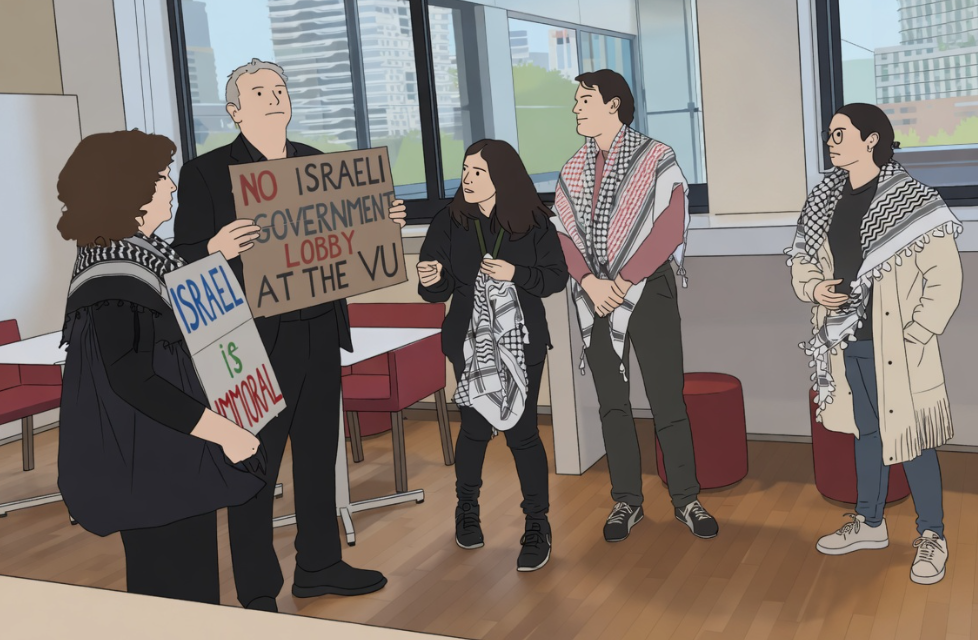
Palestine activists disrupted a symposium, then cast themselves as the wronged party — with help from a journalist.
How do you silence your opponents? It is an art form in which Palestine activists excel, as was once again demonstrated this week. A symposium on International Law was disrupted by activists, who — as usual — turned out to have very short lines to the media. A narrative has now been constructed from these events that the activists will undoubtedly use to further sabotage substantive debate.
As it happens, I was present at this symposium myself, so I am writing here as an eyewitness.
The symposium was held for a closed audience, owing to previous disruptions of events that Palestine activists deemed “too pro-Israel.” The organisers wanted a scholarly debate without shouting, and had invited academics, students, and journalists. Crucially, this included people with a range of views on the Israeli-Palestinian conflict.
Protest Against the Symposium
On 6 May, an article appeared in Het Parool (by Tahrim Ramdjan) reporting on a petition against the event. The article quoted the VU’s (Vrije Universiteit Amsterdam) own rules for such gatherings: “Meetings must be inclusive and transparent (meaning they must give voice to diverse perspectives) and openly accessible to VU students and staff, after being announced through VU channels.”
This sounds perfectly reasonable — until you remember why events sympathetic to Israel require security in the first place. To prevent them from being rendered impossible by provocateurs.
Het Parool gave a platform to professor Maurice Crul — see also my article on the government’s woke language guide — who called the symposium a “secret event.” He complained that he had not been admitted immediately, even though the venue was full by the time he registered. He was eventually admitted anyway, along with other activists.
The Parool piece gave Crul ample space to cast further suspicion on the symposium and its speakers. That Tahrim Ramdjan granted him this platform is particularly interesting in light of what happened next.
Security and Demonstrators
On Thursday morning, 7 May, I arrived at the venue at a quarter to nine. The location had only been shared the day before, for security reasons. The entrance was cordoned off with tape, and security personnel were present — an unfortunate necessity at events of this kind. The atmosphere was relaxed, and I greeted a few acquaintances over coffee in the foyer.
Then a group of demonstrators entered, Maurice Crul among them. They positioned themselves at the back of the foyer and held up signs. Some had already wrapped their keffiyehs around their faces. The other attendees ignored them. Honestly, the whole display looked rather ridiculous.
Het zullen deze lieden wel zijn.
Altijd dezelfden.
Ze zullen het wel jammer vinden dat niemand hun borden uit hun handen trekt, en gemaskerd tegen hen gaat schreeuwen.😂https://t.co/BhodMVGLOX— Maaike van Charante (@Repelsteeltje21) May 7, 2026
Translation tweet: It’ll be the usual crowd, no doubt. Always the same people. They’ll be disappointed that nobody’s snatching their signs and screaming at them from behind a mask. 😂
These people were clearly intent on disrupting the event. I found myself thinking about how these same activists behave when they organise something themselves. Don’t imagine for a second that dissenting voices are welcome there, or that anyone gets to calmly make their case.
Disruption
We were invited into the lecture hall, and everyone found a seat. Professor Jessica Roitman explained the ground rules and asked us not to take photographs or record video inside. I was sorry about that — I would have liked to document the activists’ provocations.
They sat in the back row on the left side of the hall, draped in keffiyehs with a small Palestinian flag. Initially, they appeared to behave themselves. The moderator was courteous enough to give one of the activists — VU lecturer Joram Pach — the opportunity to put a question to Professor Knoops in the very first round. He received a thorough answer, and the symposium continued.
The second speaker was Andrew Fox. At the end of his presentation, a professor in the front row suddenly leapt to his feet and launched into an emotional tirade against Fox. This Johannes de Boer held forth about 1948 and 1967, at which point Fox interrupted to ask what any of this had to do with his talk. Immediately, the activists in the back row began shouting that he should let Professor de Boer finish.
Escalation
The moderator — Professor Steve E. Zipperstein — tried to calm the shouters and asked the professor to get to his point. The question, it turned out, concerned what Andrew Fox had said about Hamas’s horrific crimes of 7 October 2023. Professor de Boer felt that Fox was dehumanising Hamas, and countered with familiar historical grievances about past IDF conduct.
More noise from the back row. The activists were clearly determined to provoke a scene, and when some other attendees reacted, they seized on it eagerly. Someone told them to be quiet or he would drag them out. That was exactly the ammunition they were looking for. Joram Pach immediately demanded that the moderator intervene.
Professor Zipperstein called for calm and returned the floor to Andrew Fox, who said that Hamas had dehumanised itself on 7 October. Predictable shouting from the activists.
Scuffle
Professor de Boer had sat back down, but the man next to him had turned around and appeared to be filming the shouting activists. De Boer tried to stop him, whereupon the man pushed him away — apparently knocking his glasses off in the process. I did not see that last part myself, but someone later sent me footage of the incident, which shows a woman behind de Boer handing him his glasses back.
That same footage also confirms what I remembered: de Boer was back in his seat and chatting calmly with his neighbour. If he had genuinely been punched in the face, would the two of them have been sitting there talking so quietly afterwards? During the coffee break, the two men apologised to each other.
This minor scuffle triggered fresh uproar, and the moderator kept calling for order. In response, the organisers urgently asked all attendees to refrain from filming or taking photographs. The man next to de Boer said he had not actually been recording — he had only pretended to.
Things quietened down after that. There were a few more questions and no further serious disruptions. During the next coffee break, the activists left. A casual observer might have concluded they had failed in their objective. In reality, they had already got what they came for.
The Activist Journalist
The two minor incidents — the glasses knocked off, and one attendee’s irritated outburst — were blown up into claims of aggression against the activists, with their own aggressive behaviour carefully omitted from the story. And the lines to the media turned out to be very short indeed.
The same journalist who had given the activists a platform in Het Parool on 6 May — Tahrim Ramdjan — had already filed a sensational piece by Thursday afternoon, published in both Het Parool and the AD, under the headline: “Professor strikes fellow professor in the face during ‘secret’ conference on Israel at Vrije Universiteit.”
The opening paragraph was equally revealing: “At the controversial conference at the Vrije Universiteit (VU) featuring ‘Israeli government lobby groups’, a professor struck a VU professor in the face on Thursday. In addition, an attendee threatened to drag a VU lecturer out of the conference.”
That is, to put it mildly, a highly coloured account of what actually took place. Ramdjan carefully omitted every provocation by the activists, while including their insinuations — which made the symposium look controversial by design. There was no attempt at hearing the other side.
De bril van de hoogleraar viel daarbij op de grond. Maar van een klap of “uithalen”, zoals Het Parool suggereert, was geen sprake. Dat onderscheid is essentieel. Blijkbaar hoort wederhoor niet bij de journalistiek van Het Parool.https://t.co/r47PslIH7X
— CIDI (@CIDI_nieuws) May 8, 2026
Translation tweet: The professor’s glasses fell to the floor. But there was no punch, no “assault” — whatever Het Parool implies. That distinction matters. Apparently, Het Parool’s journalism has no room for hearing the other side.
What Actually Happened
Anyone who reads only Ramdjan’s second piece would have no idea that the symposium contained genuinely interesting content, or that there was extensive time for questions — including critical ones. That is not to say there were no moments of friction.
An NRC journalist who had put a question to Professor Danny Orbach — one of the speakers — received a sharp dressing-down from Anne Herzberg of NGO Monitor, over an NRC article she said had published defamatory claims about her organisation. NRC is not known for its pro-Israel stance, but this journalist did not disrupt the event. His subsequent write-up was not neutral, but it did mention the aggression from the activists’ side.
At the close of the event, a critical professor said the symposium had not delivered what he had hoped for. Fair enough — that can always happen. But for those willing to listen, there was substantive material from four very different experts, each with significant expertise in their field, who gave extensive answers to the questions put to them.
Sabotaging Debate
We should be having far more of these substantive discussions. Events with experts who present evidence and can be rigorously questioned, without people sitting in the back row screaming and goading others. That was precisely what the organisers had set out to create. But the activists who disrupted this event are not interested in substantive debate.
They want to disrupt gatherings where views other than their own are given a hearing. Only their perspective is permitted. And when others try to organise a genuine debate in a secure environment that keeps these saboteurs out, they wriggle their way in anyway, cause a commotion, and then retreat into the victim role.
This cowardly tactic only works because journalists like Tahrim Ramdjan play along, and because universities are too spineless to name what is actually happening. That was once again clearly visible in the VU’s feeble response.
Typerend weer, deze slappe reactie van de VU.
Geen woord over de oorzaak van het rumoer: de provocaties van de Palestina activisten. Zij verstoorden deze bijeenkomst.Valt dit érgens uit op te maken?
Liever schuift de VU de schuld op de organisatie.https://t.co/rVZSEOqo47— Maaike van Charante (@Repelsteeltje21) May 8, 2026
Translation tweet: Typical. The VU’s limp response. Not a word about the cause of the disruption: the provocations of the Palestine activists. They disrupted this event. Is there anything in this statement that even hints at that? Instead, the VU shifts the blame onto the organisers.
The Consequences
It is extraordinary that the university nowhere mentions who caused the disruption. One can only fear that events like this symposium will soon be prohibited on the grounds that “constructive dialogue” is, in the VU’s words, “difficult to impossible.” Capitulating to aggressive activists is always easier than safeguarding the safety of minorities.
People like Joram Pach and Maurice Crul talk endlessly about inclusivity and diverse perspectives. But they are the ones who will only tolerate a single perspective. Everyone else must be silent. And they have exactly the right connections to make that stick.
Universities ought to understand what happens when you give ground to bullies.
The light of freedom will fade.
This article was originally published in Dutch.
You can support Maaike van Charante at repelsteeltje.backme.org
Want to stay up to date with new articles and podcasts? Follow Maaike on Twitter.