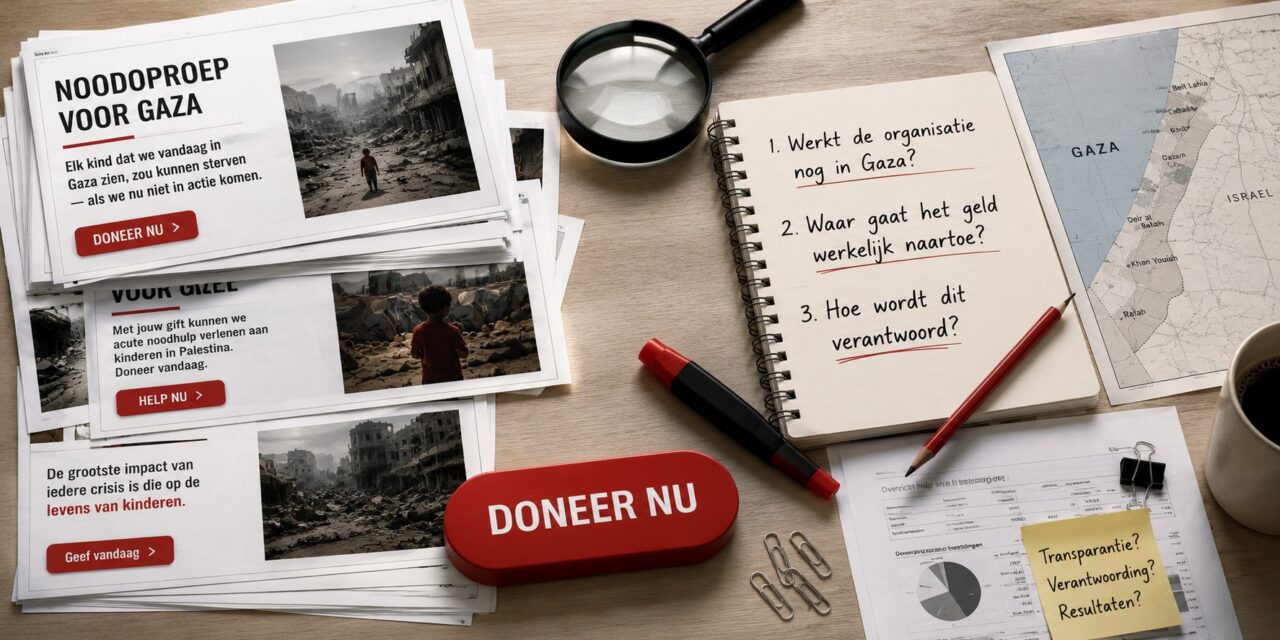
Save the Children in the Netherlands is fundraising for the children of Gaza while the NGO no longer works in Gaza. The organisation calls itself impartial, yet it refuses any involvement from Israel while accepting it from Hamas. It also has a rather casual approach to the facts. In this piece I take a closer look at Save the Children and ask the questions every journalist and every politician ought to be asking.
For weeks now, Save the Children has been running a major campaign in the Dutch media to raise money for the children of Gaza. But Save the Children has refused to meet the Israeli conditions for working in Gaza. How can you ask for donations for Gaza when you no longer work there?
Time to look into this more closely.
No Israeli registration
Israel has introduced a new registration requirement for aid organisations operating in the Palestinian territories. The reason is that terrorists like posing as ‘aid workers’, because it offers them protection: Israel would rather not kill civilians. Several aid organisations turned out to have militants on the payroll. According to NGO Monitor, Save the Children too employed questionable figures.
That is why Israel wants aid organisations to disclose who works for them, so it can check whether staff pose a security risk. Many organisations cooperate because they recognise the rationale for it, but Save the Children was one of the organisations that refused. The Dutch newspaper NRC interviewed a doctor who did accept the Israelis’ security checks, and recorded this quote from him.
‘I recently spoke to people from Save the Children, who called me immoral and smug because I work with the Israeli government. Look, there are wonderful people working at Save the Children and those other NGOs. I wish they would change their minds and come back to work in Gaza. If they don’t, thousands of people will starve. And I’m the one who is immoral and smug?’
Giving in to Hamas
Anyone who wants to provide aid in a war zone will have to work with the warring parties, whether those parties are decent or not. It is striking that Save the Children has objections of principle to registration with Israel, but takes interference from Hamas in its stride. In December 2025 a report was published on aid money reaching Hamas via NGOs. One of the NGOs named was Save the Children.
Save The Children distributed $23M in cash in Gaza between November 2023 and June 2025.
Cash and Voucher Assistance is the single most guaranteed way to ensure aid money reaches the hands of terrorists. It is a global problem.
My paper, Cash To Terror:https://t.co/Ebgr33fFWN pic.twitter.com/tOv4Cxl4M8
— Andrew Fox (@Mr_Andrew_Fox) July 15, 2026
That does not mean Save the Children deliberately channels money to Hamas, but it is virtually impossible to work in Gaza without Hamas taking advantage of you. Hamas’s own documents show how the terror group places agents within various NGOs to keep those NGOs under surveillance.
Anyone who wants to keep their hands clean should stay out of Gaza. Anyone who nevertheless wants to help the people there must accept that this comes at a price. The contradiction is that Save the Children does accept interference from Hamas, but not from Israel. Even in the Netherlands the NGO worked with the Hamas-linked organisation PGNL (Palestinian Community Netherlands) to organise pro-Palestinian demonstrations (the Red Line demonstrations).
De Palestijnse Gemeenschap Nederland (PGNL), koepel van acht Hamas-gezinde organisaties, in 2016 opgericht op initiatief van pro-Hamas-activist Amin Abou Rashed, mag een spreker leveren bij de Rode Lijn. https://t.co/6gwpGC8fv3 pic.twitter.com/LdCgSIlOQR
— Carel Brendel (@CarelBrendel) October 4, 2025
Tweet text: The Palestinian Community in the Netherlands (PGNL), an umbrella organisation comprising eight Hamas-affiliated organisations, founded in 2016 on the initiative of pro-Hamas activist Amin Abou Rashed, is permitted to provide a speaker for the Red Line.
Impartial
And speaking of the Red Line demonstrations: Save the Children proudly reported on every one of them, each time setting out fresh demands. These were invariably demands on the Dutch government to put pressure on Israel, never on Hamas. That goes for the first, the second and the third Red Line demonstration alike. The third time, the organisers even demanded — in defiance of all the facts — that the Netherlands acknowledge that Israel is committing genocide in Gaza.
Anyone searching the Save the Children website for blistering denunciations of Hamas had better stop searching. At the bottom of a post about a meeting with Prime Minister Schoof (the previous Prime Minister of the Netherlands) the small print does say that Save the Children ‘has always condemned the atrocities of Hamas’, but no such condemnation is anywhere to be found. Not on social media, and not in the statement issued immediately after 7 October, which lamented the ‘escalation of the violence’. The name Hamas did not appear in it.
What the organisation did write in that statement was: ‘Save the Children is an impartial humanitarian organisation, which means that we do not take sides in a conflict.’ Anyone who looks at Save the Children’s communications sees no impartiality whatsoever. Hamas features there in subordinate clauses at best, while Israel is under constant suspicion. A fine example of the latter is a rickety ‘report’ on the mistreatment of Palestinian minors in Israeli prisons.
Donating for Gaza
But to return to the current advertising campaign: Save the Children has refused to meet the Israeli security requirements, and therefore no longer has access to Gaza. How is it possible, then, that the organisation is nonetheless asking for donations for Gaza? When I emailed Save the Children with this question, the reply I got was: ‘Although Israel is trying to make things ever more difficult for aid organisations, we have fortunately been able to continue our work.’
Remarkable. On its website, Save the Children writes that without registration it cannot get people or aid supplies into Gaza, and that it is taking ‘legal action’ against Israel. Nowhere does it say that access has since become possible again. Which makes the information page where donors to this campaign land rather interesting.
At the top it says: ‘Help children in Gaza’. But read on and you find a sentence with a barb in it. ‘With your donation we are there for the children who need it most, such as in Gaza.’ Such as in Gaza? That sounds as though the NGO uses the name Gaza to attract donations and then spends the money (mainly) on other causes.
Gaza as a cash cow?
In July 2026 a report was released by a group of former employees of various NGOs. They interviewed dozens of current and former staff at NGOs involved in aid to Palestinians. A quote: Staffers at both MSF and Amnesty described how images of Palestinian suffering “played well” with donors — and were promoted accordingly. And another: At Amnesty International Australia, one staff member described Gaza as a “particularly effective fundraising engine.”
International humanitarian and human rights groups neglected antisemitism complaints from staffers, exploited suffering in Gaza for fundraising and sought to shape an anti-Israel narrative around the Gaza war, according to a report released this week.
The 63-page report by the… pic.twitter.com/fyXktJu7Ul
— The Times of Israel (@TimesofIsrael) July 5, 2026
These comments came from behind-the-scenes conversations at several NGOs. Gaza turns out to be a magic word for bringing in money; a particularly effective fundraising engine indeed. Is that how Save the Children is now using the name Gaza? While the money that comes in cannot — or only indirectly — be spent on children in Gaza?
Drama works
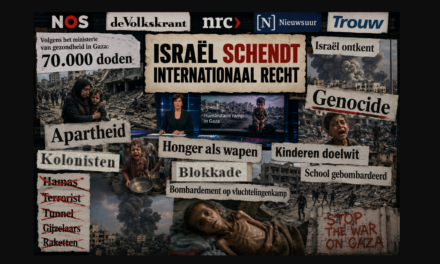
It would be dubious enough in itself to ask for money for one good cause and then use it for others, but the report by the NGO employees highlighted an even more troubling issue. Why are people so eager to give for Gaza? Because the suffering there is said to be so terrible. So if NGOs want to bring in large donations for Gaza, it is in their interest to portray the situation there as dramatically as possible.
On that score too, Save the Children has a questionable history. In July 2025 the Reclame Code Commissie, the Dutch Advertising Standards Authority, ruled that Save the Children had misled the public with a campaign claiming that 70% of the dead in Gaza were women and children. That figure was based on Hamas propaganda which had been corrected a full year before the campaign ran. And it was not the only time the NGO put out false information in campaigns about Gaza.
The IPC Famine Review Committee — of which Save the Children is a member — stated in May 2025 that 93% of all children in Gaza were at acute risk of famine. However, the scientific basis of this report came under fierce criticism, and although the IPC Famine Review Committee did respond to this itself, this response cannot be found on Save the Children’s website. What Save the Children did publish, in August 2025, was an argument claiming that the number of children in Gaza at risk of acute malnutrition had doubled since May 2025. The number of starving children — twice 93% — would then amount to almost double the total number of children in Gaza…
Influence
It is so easy to demonstrate that organisations like Save the Children, firstly, are careless with facts and, secondly, consistently take sides against Israel. And yet these people regularly sit down with officials from the Ministry of Foreign Affairs — with whom they write dubious open letters — and they are welcomed for talks by one Prime Minister after another.
Politicians listen to them. In June 2025 GroenLinks/PvdA (left-wing bloc in the Dutch parliament) voted for the Piri motion (named after its sponsor, MP Kati Piri), which sought to withdraw Dutch support for Israeli civil defence. In doing so, the parliamentary group knowingly accepted the risk of tens of thousands of Israeli civilian deaths. How could these MPs agree to such a disgraceful motion?
The Dutch newspaper de Telegraaf uncovered what had gone on behind the scenes. ‘They made the U-turn because they were afraid the party conference would become even more radical.’ They are also said to have felt NGOs such as Oxfam Novib, Médecins Sans Frontières and Save the Children breathing down their necks.’ NGOs putting pressure on MPs to endanger innocent civilians… what a sorry business.
Zo ging het dus achter de schermen bij de motie Piri.
Fractieleden werden voor het blok gezet: dit belangrijke besluit werd de avond van te voren via een appje medegedeeld.Dit stukje👇 zegt trouwens ook wel iets over de (anti-Israël) druk vanuit ngo's.https://t.co/H8YM2pKjlm pic.twitter.com/9yrP3wprHR
— Maaike van Charante (@Repelsteeltje21) June 26, 2025
Tweet text: So that’s how things went behind the scenes with the Piri motion. Party members were put on the spot: they were informed of this important decision the evening before via a text message. Incidentally, this bit 👇 also says something about the (anti-Israel) pressure from NGOs.
Who checks the NGOs?
And the ever-harder line the Netherlands takes towards Israel, which these NGOs manage to bring about, only makes them bolder. Current Prime Minister Rob Jetten — who took selfies at the Red Line demonstration during the election campaign — was handed an ultimatum by the NGOs. Within 30 days he was to step up the pressure on Israel even further. Because according to these NGOs, children in Gaza were — in May 2026 — still dying of hunger.
It is becoming a familiar pattern, but the latest studies — based on Palestinian figures — show that the food supply in Gaza is good. Better, in fact, than before the war. Anyone who takes the time to inform themselves can know this. Footage from Gaza shows well-fed children. In August 2025, news photographs of emaciated children turned out, without exception, to show children who were gravely ill.
Does that mean there is no misery at all in Gaza? Of course not. But the NGOs have been caught exaggerating the suffering in Gaza time and again. They raise money with it, and they influence politics. It is bizarre that most media do not check them, and that politicians are afraid of them.
After that first exchange of emails, I asked Save the Children what share of the donations received will actually go to the children in Gaza, and how they guarantee this. I also asked whether they provide a public accounting of this afterwards in an annual report or some other public reporting. That question has not yet been answered.
NGOs are not saints or prophets. Like everyone else, they should be subject to critical scrutiny.
Update 1 August 2026: In both May 2024 and May 2025, there was a furore over an alleged famine in Gaza, and on both occasions the furore turned out not to be based on hard facts. However, in my article, I accidentally placed the refutation of the May 2024 controversy after the new controversy in May 2025. That is, of course, incorrect. That refutation has now been replaced by the refutation from 2025. This concerns the paragraph immediately above the subheading ‘Influence’.
This article was originally published in Dutch.
You can support the work of Maaike van Charante at repelsteeltje.backme.org
Want to stay up to date with new articles and podcasts? Follow Maaike on Twitter.