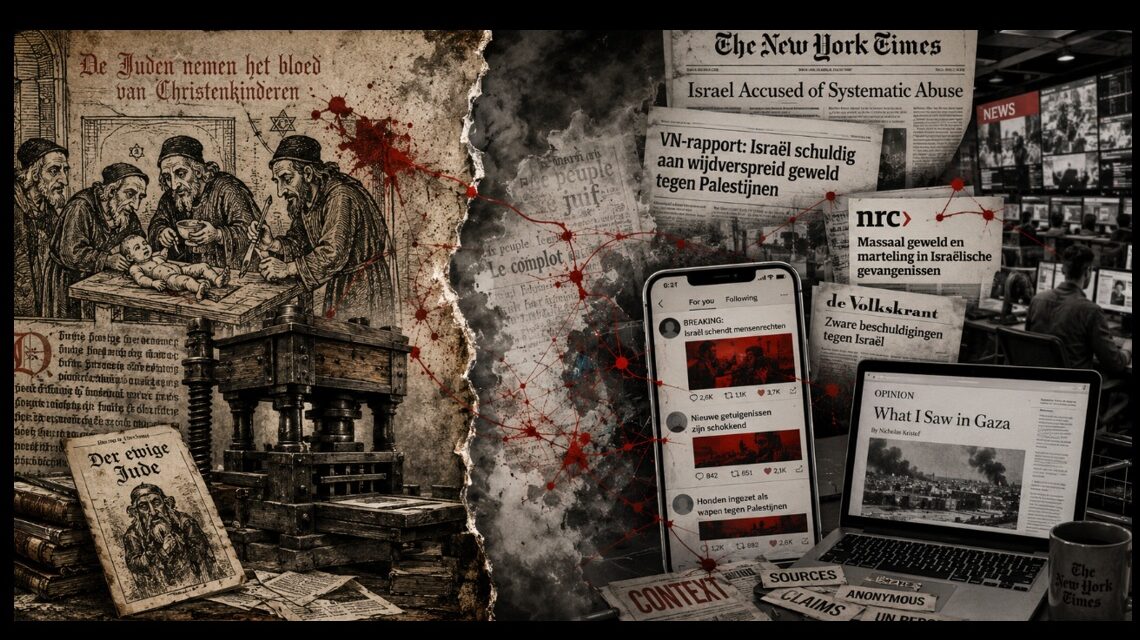
After the Holocaust, antisemitism fell into disgrace, and blood libels were banished to the despised fringes of society. Now we are witnessing a revival of Jew-hatred — one that coincides with the erosion of journalistic integrity. Both the Dutch quality press and the once-respected New York Times are helping to create a climate in which antisemitism is becoming socially acceptable again.
In the Middle Ages, blood libels circulated about Jews. The most famous is the recurring tale — told in countless variations — that Jews murdered Christian children to use their blood for baking matzah, the traditional unleavened bread eaten during Passover. Hence blood libel.
Medieval blood libels told grotesque, demonising stories about Jews, and frequently served as pretexts for pogroms. A recurring theme was that Jews had it in for defenceless innocents. We like to think of ourselves as more enlightened than our ancestors. But the fact-free slander now circulating about Israel bears an uncomfortably close resemblance to the old blood libels.
Context
Today’s blood libels are no longer confined to dog-eared antisemitic pamphlets. They are published in our mainstream media. Nu.nl (one of the Netherlands’ most-visited news sites) ran three blood libels in a single article this week, apparently as a way of providing ‘context’ around the release of a damning Israeli report on the atrocities committed by Hamas on 7 October 2023.
Kenmerkend voor NL verslaggeving over Israël.👇
Een zeer degelijk rapport over sadistisch seksueel geweld door Hamas oppervlakkig bespreken.
Dan er vlug feitenvrije Palestijnse bloedsprookjes🤮 tegenover te zetten die wél de NL media halen.https://t.co/tFyK3JZRKf— Maaike van Charante (@Repelsteeltje21) May 13, 2026
Translation tweet: Characteristic of Dutch reporting on Israel. 👇 A thoroughly documented report on Hamas’s sadistic sexual violence — given a cursory mention. Then quickly offset with fact-free Palestinian blood libels 🤮 that do make it into the Dutch media.
Let me provide some context of my own. The Israeli report is based on more than 10,000 photographs and videos — over 1,800 hours of footage in total, some of it posted online by Hamas itself. This evidence is supplemented by more than four hundred testimonies from survivors, eyewitnesses, released hostages, experts, and family members.
The blood libels, by contrast, rest on poorly substantiated claims made by people who hate Israel.
Sexual Violence Against Women in Gaza
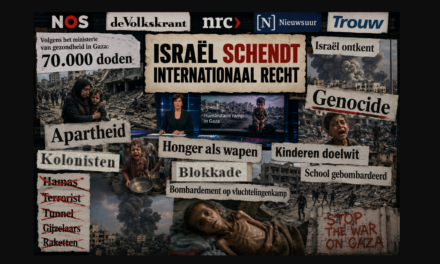
The oldest blood libel published by Nu.nl dates from March 2025. At the time, a report was released by the UN’s notoriously politicised Human Rights Council (UNHRC) — an institution that, as usual, was not named as such. “The UN says” is the standard authority-lending formula, and it was the same formula I kept encountering when I looked into the content the NOS produces for young audiences.
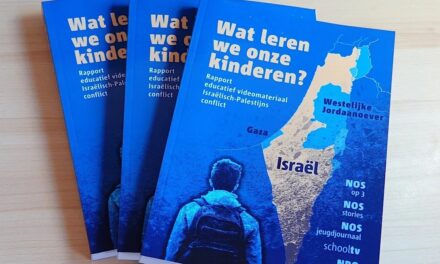
NOS Stories (the Dutch public broadcaster’s youth platform) produced a video about this ‘report’ — so I read it, and checked its claims. Dutch media could, incidentally, also check such a report (just a tip). For a detailed analysis, see analysis 15 in appendix 1 of our report What Are We Teaching Our Children? Setting aside the UNHRC’s overt hostility towards Israel (see the analysis), the most serious allegations were simply unsubstantiated.
One example: if IDF soldiers ask women in Gaza to remove their veils — a fairly standard security measure in a war zone, to identify possible combatants — the report counted that as sexual violence. Another example: not a single woman in the entire report was identified as having been raped by Israelis. Everything rested on third-hand accounts. And yet the report concluded that “systematic rape” had taken place.
The Torture of Palestinian Children
The second Nu.nl story is more recent. Save the Children levelled serious accusations of widespread torture and sexual abuse of Palestinian children in Israeli detention. NRC ran the story; NOS, the Volkskrant, and Trouw repeated it uncritically. Israel committing atrocities against Palestinian children? Well, that had to be true.
De @nos neemt het klakkeloos over
👇👇👇
Save the Children: Palestijnse kinderen gemarteld en misbruikt in Israëlische cellen – https://t.co/IS1z48mEnM— VerschoorD57 🇮🇱🎗️ (@VerschoorD57) April 10, 2026
Translation tweet 1: NRC kindly offers readers a crash course in both the Palestinian inversion and the blood libel. Tweet 2: The NOS just runs with it. 👇👇👇
But what was Save the Children’s evidence? The report is based on interviews with 165 Palestinian minors held in Israeli detention — mostly older teenagers who had carried out attacks or thrown stones — supplemented by statements from parents, aid workers, and lawyers. These are stories. Stories from a population that is already engaging in violence against Israel.
Save the Children cites no medical examinations. No photographs of injuries or scarring. No testimony from Israeli whistleblowers or anyone else. That does not mean every allegation is automatically false. But is a shred of supporting evidence really too much to ask?
Trained Rape Dogs
The third story appeared last week. It contained accusations about dogs trained to rape Palestinians, and it was published by the New York Times. There is not a scrap of evidence for the dog story — as one of the piece’s own ‘sources’ acknowledged in an interview. The remaining accusations in the article likewise trace back to anti-Israel activists.
For those who say that evidence for such crimes is difficult to obtain: that is true. But extreme allegations should at the very least be made credible by supporting evidence, such as medical reports documenting injuries inflicted, video footage, or scientific research into whether certain allegations are biologically possible at all.
Moreover, the “witnesses” in Nicholas Kristof’s piece include people who glorify terrorism, celebrate the 7 October massacre, give constantly shifting versions of their victim narratives, have ties to Hamas, or openly state that Israel should be destroyed. Are these reliable sources to believe in the absence of any supporting evidence?
In an attempt to lend the piece some credibility, Kristof put words in the mouth of former Israeli Prime Minister Ehud Olmert, implying that Olmert found the allegations plausible. Olmert has since publicly repudiated this claim and informed the New York Times accordingly. None of this stopped Nu.nl from citing Kristof’s opinion piece approvingly.
Timing
It is hard to decide what is most outrageous about this piece. The publication of fact-free slander? The whitewashing of Israel-haters as credible sources? Or the timing? The New York Times knew when the Israeli report on 7 October was due to be released — and was not interested in covering it. Instead, the paper published this blood libel just before that report appeared.
Now we know @nytimes & @NickKristof knew precisely the timing of the release of a new major report on Hamas' sexual violence on 10/7. They declined to publish a story about it and then they preempted its release with the fake "dog rape" and Hamas front Euro-Med trash. Shameful. https://t.co/xo69RcKxzy
— Aizenberg (@Aizenberg55) May 12, 2026
The New York Times in Decline
The piece provoked a storm of criticism, and the New York Times published a statement. The screenshot is in the tweet below. The Times claims the opinion piece was rigorously fact-checked and that independent experts were consulted. It is unlikely the paper can substantiate either claim.
Corroborated by their support for the article specifically as "opinion" journalism not standard, fact checked journalism. That (cowardly) word says it all and does all the work for this notice. pic.twitter.com/bGhfmZ7UAH
— Aizenberg (@Aizenberg55) May 14, 2026
The situation has become even more awkward for the Times editorial team now that the Israeli government has formally intervened. Can the paper hide behind the reputation of the journalist — Nicholas Kristof, a two-time Pulitzer Prize winner — or behind its own standing as a paper of record? Anyone can read the piece and see its weaknesses for themselves.
Following the publication by Nicholas Kristof in The New York Times of one of the most hideous and distorted lies ever published against the State of Israel in the modern press, which also received the backing of the newspaper, Prime Minister Benjamin Netanyahu and Foreign…
— Israel Foreign Ministry (@IsraelMFA) May 14, 2026
And anyone paying attention knows that the New York Times has been drifting steadily away from its own journalistic standards for years. Activists have effectively hollowed out editorial oversight. In 2017, the Times abolished the role of Public Editor. Publisher Arthur Sulzberger Jr. declared that henceforth “readers and followers on social media would collectively serve as a modern watchdog.”
In June 2020, as American cities were literally burning during the BLM riots, the Times published a piece by a Republican senator calling for the deployment of the National Guard. Activists within the newsroom turned on their own colleagues. Two members of the opinion staff — James Bennet and Adam Rubenstein — were forced out.
Undermining Credibility
Trust arrives on foot and leaves on horseback. Papers that once earned a solid reputation through good journalism cannot keep drawing on that reputation while violating journalistic norms and dismantling quality control. The same applies, of course, to the Dutch quality press, which is ignoring its own standards in order to pursue anti-Israel activism.
The problem is not that critical articles about Israel appear in prestigious outlets. The problem is that articles appear — as in the New York Times this week — that lack solid evidence, rely on unreliable sources, and present information selectively. If these media genuinely wanted to document wrongdoing by Israel, they would conduct conscientious investigations and verify their sources.
If they were genuinely concerned about potential victims of Israeli misconduct, they would not be spreading fact-free blood libels. They would report honestly and in a balanced way. The quality of these anti-Israel reports and articles tells us little about any actual Israeli wrongdoing. It tells us everything about the media outlets publishing them.
“Een week na 7-10 was al zichtbaar wat de trend van de verdere verslaggeving zou zijn. De focus lag op het leed in Gaza, de rol van Hamas was zo klein mogelijk, en alles wat begrip voor Israël kon wekken bleef bijna volledig buiten beeld.” @Repelsteeltje21 https://t.co/5NDTDykxAr
— 𝐆𝐮𝐮𝐬 𝐆𝐮𝐭𝐢𝐞𝐫𝐫𝐞𝐳 (@GustafGutierrez) May 10, 2026
Translation tweet: “A week after 7 October, the pattern of future coverage was already visible. The focus was on suffering in Gaza, the role of Hamas was minimised as much as possible, and anything that might generate sympathy for Israel was almost entirely absent from the picture.”
Why Blood Libels Are Popular
Blood libels are, sadly, a constant in history. Jew-hatred appears so deeply embedded in our collective unconscious that virtually every accusation, sooner or later, ends up pointing at Jews. It is always convenient to have a scapegoat to channel social discontent without threatening the interests of the established order.
In both Christian and Islamic societies, opportunists could build on resentment towards the ‘parent religion’ that refused to acknowledge the superiority of the new religion. Furthermore, centuries of persecution forced Jews to develop survival strategies which, once again, made them objects of suspicion.
Every expulsion produced new international networks — which fed conspiracy theories about secret world domination. Bans on entering certain professions drove Jews into finance — the Jews control the banks! — and into art and science. That Jews excelled in these fields only generated fresh resentment.
The old hatred of Jews has now turned its sights on the Jewish state. After hate campaigns by Islam, Christianity, Nazism, and the Soviet Union, Israel has become the scapegoat onto which the West projects its own sins. Europe, moreover, is eager to be rid of its Holocaust guilt. If the Jews themselves are the new Nazis, our guilt diminishes.
The resurgence of ancient Jew-hatred and the erosion of journalistic integrity make for a toxic combination. We see the results daily — in our media, in our parliaments and in our streets.
The blood libels themselves are not the biggest problem. The biggest problem is that they are welcomed by our ‘quality media’, which is helping to make antisemitism salonfähig again.
This article was originally published in Dutch.
You can support Maaike van Charante at repelsteeltje.backme.org
Want to stay up to date with new articles and podcasts? Follow Maaike on Twitter.