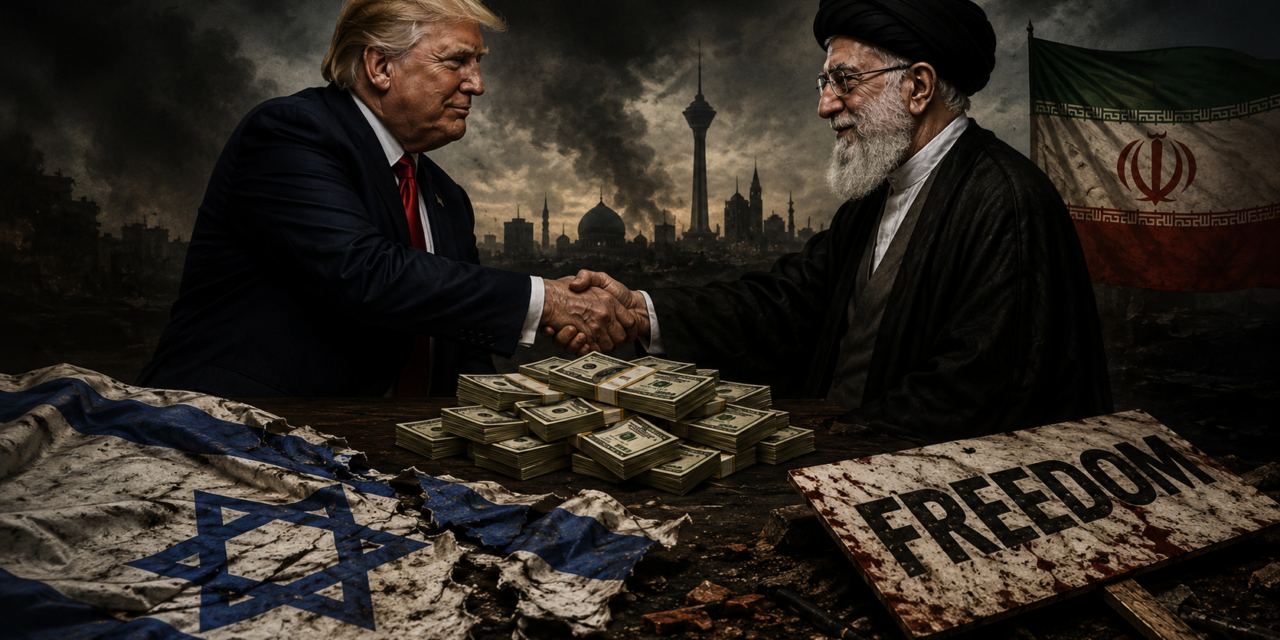
For years, President Trump has accused his predecessor Obama of having struck a bad deal with Iran — but now he’s planning an even worse one himself. The Iranian regime gets almost everything it wants and barely has to give anything in return, while both Israel and the Iranian protesters are being left in the lurch. Let’s hope the further negotiations fail.
After nearly four months of war, Trump has struck a deal with Iran — or rather, a Memorandum of Understanding, a statement of intent. This deal is so bad that nobody is happy with it. Trump-haters are crowing that this is yet more proof that Trump is an idiot, while the rest of the world is bewildered, trying to work out what’s really behind it.
The Memorandum of Understanding consists of fourteen points laying out various commitments and promises. Over the next sixty days, Iran and the US will continue negotiating, and within two months a final peace agreement is supposed to be in place, to be ratified by a binding UN resolution.
No Self-Defence for Israel
The first point is a slap in the face for Israel. The US, Iran, and their allies — including Israel, which wasn’t allowed a seat at the table — must immediately halt the fighting on all fronts, including in Lebanon. Of course, Israel isn’t at war with Lebanon, but with the terror group Hezbollah — Iran’s forward outpost — which has used Lebanon as a launchpad to attack Israel for decades.
With this point, Trump undermines Israel’s right to self-defence — and Iran’s leaders have grasped that perfectly well. In the video below, the Iranian signatory of the statement of intent says: We negotiated with the murderers of our martyred leader. If we seek justice, then justice for our imam lies in the liberation of Jerusalem.
Just FYI, Iran is openly planning to launch more endless wars. To invest more in proxies whose sole reason for existence is war.
Call the MOU whatever you want, but don’t call it a peace deal.
And for pity’s sake, don’t pretend like the mass murderers of their own people are… https://t.co/X0UGWViBE0
— Haviv Rettig Gur (@havivrettiggur) June 18, 2026
Don’t be fooled by the euphemistic phrase “the liberation of Jerusalem” — Mohammad Bagher Ghalibaf means the destruction of Israel, and the subjugation, expulsion, or extermination of all Israelis. The Iranian regime and its terror branches — like Hezbollah — have never made a secret of their genocidal intentions.
The agreement states that the ceasefire takes effect immediately upon signing, meaning Israel can no longer continue dismantling Hezbollah’s military infrastructure. It is unprecedented for the US to force an ally into something like this. For Israel, Hezbollah’s power — built up under the eyes of UN troops who were supposed to prevent exactly this — constitutes an existential threat.
Bribing Iran
Does this mean Trump doesn’t care about Israel’s security? That’s hard to say. It looks as though he thinks that, in the end, everyone only cares about money — and that he can therefore bribe the religiously fanatical Iranian regime. If that’s genuinely the thinking behind this deal, it’s dangerously naive. And yet bribery does seem to be the core of this statement of intent.
Points four, six, seven, ten, and eleven are all about financial concessions to Iran. The US will lift the blockade of Iranian ports, commit to ending all sanctions, reopen trade with Iran, unfreeze frozen assets, and promise a reconstruction fund. That last item involves the astronomical sum of 300 billion dollars.
The statement reads as though Iran has won the war and can now dictate terms to the losers; the ‘reconstruction fund’ inevitably brings to mind war reparations. Trump claims not a single cent of American taxpayer money will go to Iran — but where does he plan to get this huge sum from? He seems to think he can talk Arab countries into chipping in. These are countries that Iran itself shelled in early March.
In the past 24 hours, Iran has attacked, directly or indirectly, 15 different countries or their military:
– 🇮🇱 Israel
– 🇺🇸 United States
– 🇦🇪 United Arab Emirates
– 🇸🇦 Saudi Arabia
– 🇶🇦 Qatar
– 🇰🇼 Kuwait
– 🇯🇴 Jordan
– 🇮🇶 Iraq
– 🇧🇭 Bahrain
– 🇴🇲 Oman
– 🇸🇾 Syria
– 🇨🇾 Cyprus
– 🇫🇷…— Visegrád 24 (@visegrad24) March 1, 2026
Point five does, for once, contain an actual Iranian concession: lifting the blockade of the Strait of Hormuz. Iran imposed this blockade to pressure Trump via rising oil prices worldwide — which has indeed affected American polling numbers. It’s as if Iran took a hostage, and Trump is now willing to pay an absurdly high ransom to get that hostage back.
Iranian Protesters
The Iranian protesters also get a slap in the face. Here is the text of point two: The United States of America and the Islamic Republic of Iran undertake to respect each other’s sovereignty and territorial integrity, and to refrain from interfering in each other’s internal affairs. It isn’t hard to guess what “internal affairs” refers to.
In early January, Trump made several appeals and promises to the Iranian people. If Iran shot at protesters, he said, Trump would come to their aid. ‘Help is on its way.’ Iranians took to the streets en masse and were slaughtered by the tens of thousands. Hope briefly flickered when Israel and the US struck; that hope has now been crushed.
Punt twee in de Irandeal van Trump:
The United States of America and the Islamic Republic of Iran undertake to respect each other's sovereignty and territorial integrity and to refrain from interfering in each other's internal affairs.Waar denkt u aan bij ‘internal affairs’?🤨 pic.twitter.com/BhFhvuxXL6
— Maaike van Charante (@Repelsteeltje21) June 18, 2026
Translation tweet: Point two in Trump’s Iran deal: The United States of America and the Islamic Republic of Iran undertake to respect each other’s sovereignty and territorial integrity and to refrain from interfering in each other’s internal affairs. What comes to mind when you hear the term ‘internal affairs’?
Nuclear Weapons
Points eight and nine concern Iran’s efforts to obtain nuclear weapons. These points are extremely shallow. They state that Iran promises not to pursue nuclear weapons, and that everything — including its stockpile of enriched uranium — may remain as it is for the time being. This looks suspiciously like the Iran deal Obama struck in 2015, which Trump fiercely criticised. But his deal is worse.
That’s also clear from points twelve and thirteen, which set out the order in which the plan’s points are to be implemented. First the fighting stops — including in Lebanon — then the US lifts the blockade of Iranian ports, then Iran opens the Strait of Hormuz, and only after that do the first sanctions disappear and frozen assets get released.
Tackling the nuclear programme comes only later, and the demands are weak. Iran doesn’t have to destroy its stockpile of enriched uranium, for instance — that’s left for later talks. But by then, Trump will have already given up every means of forcing the regime’s hand. The question a journalist puts to Vice President JD Vance in the video below is therefore entirely fair.
“What's stopping Iran from down the road restarting their nuclear program?”
JD: “They would have to get a lot of money in order to rebuild their nuclear program. You’re talking about billions."
Yeah if only they got $300 billion from somewhere, right? pic.twitter.com/87CvNClFFA
— 𝐍𝐢𝐨𝐡 𝐁𝐞𝐫𝐠 🇮🇷 ✡︎ (@NiohBerg) June 18, 2026
Nioh Berg’s point about the 300 billion dollars is also fair. What war damage has Iran actually suffered? Mostly military damage, since both the US and Israel struck military targets. So what will this ‘reconstruction fund’ mostly end up paying for? Military targets.
A Bad Negotiation
The agreement contains further problematic details, such as the vague commitment (point four) that the US will withdraw from ’the region.’ What does this mean? Out of Iran itself? Out of the Persian Gulf? Out of the entire Middle East? And what to make of the provision in point five that Iran will ensure commercial shipping through the Strait of Hormuz can resume? Does that mean Iran won’t permit military shipping?
There are countless details on which the Iranian negotiators can still score points, and the few things that have actually been finalised consist mainly of commitments by the US and Israel, not by Iran. For instance, the word ‘terrorism’ does not appear anywhere in the entire text, even though it is precisely the export of Iranian terrorism in the region that is such a huge problem. Is Iran ‘simply’ allowed to continue sponsoring Hezbollah and Hamas?
It’s no accident that Mark Dubowitz, CEO of the Foundation for Defense of Democracies, sighed (52:06) that probably never before in American history had so much been achieved on the battlefield and squandered at the negotiating table.
Why?
How is this even possible? Is Trump a bluffer who has finally overplayed his hand? Has he betrayed Israel and the Iranian protesters out of unscrupulous opportunism, just as he abandoned the Kurds in 2019? Some still hope it will suddenly turn out that Trump has been playing a masterful game of deception, and will yet destroy the ayatollahs. But I doubt it.
Israeli analyst Dan Schueftan spoke about the deal. He also addressed the moral decay in the West that became especially visible after the fall of the Soviet Union. Western norms and values no longer count for much: rights and freedoms are wavering. Self-hatred is rampant, and cultural relativism means we’re already bowing to outside demands before they’re even fully made.
Sterke analyse van Dan Schueftan bij @jonsac over de rampzalige Irandeal van Trump, en waar de VS, Israël en Europa nu staan.
"Israel is challenging the entire Zeitgeist that has developed in democratic countries after the collapse of the Soviet Union."https://t.co/JLBSuQfiT7
— Maaike van Charante (@Repelsteeltje21) June 17, 2026
Translation tweet: A compelling analysis by Dan Schueftan of Trump’s disastrous Iran deal, and where the US, Israel and Europe stand now. ‘Israel is challenging the entire Zeitgeist that has developed in democratic countries after the collapse of the Soviet Union.’
What is today’s West supposed to do with a small country that stubbornly clings to its own identity, and defends Western norms and values right in the heart of the adored religion of Islam? Israel defies the imposed victim hierarchy — and worse, does so successfully. Surely, they must be Nazis.
Schueftan thinks Western self-hatred may play an even bigger role in the aversion to Israel than antisemitism does. He sees this mentality gaining ground in the US too, and as soon as it starts affecting the polls, President Trump will be sensitive to it. Could that be why he wants to close this dreadful deal? Whatever the reason, the deal isn’t final yet.
Let’s hope Trump still course-corrects. If only out of vanity — since both supporters and opponents agree he’s the loser in this deal.
You can support Maaike van Charante via repelsteeltje.backme.org.
Want to stay updated on new articles and podcasts? Follow Maaike on Twitter.