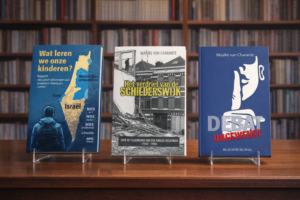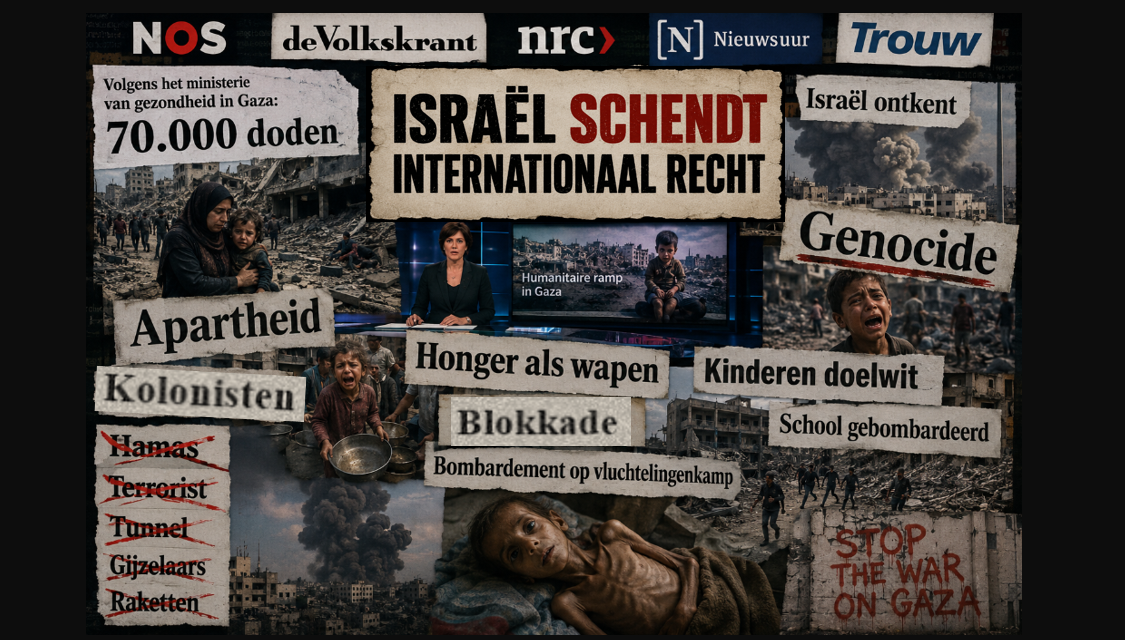
On 5 May 2026, the Dutch publishing house Ezo Wolf published a collection of essays entitled ‘Woe to Those Who Call Evil Good’. This collection focuses on the sharp rise in anti-Zionism and anti-Semitism. At the request of historian Martin Harlaar, I wrote (in Dutch) the long-form article below for the collection, examining the role of the Dutch media since 7 October 2023.
On 18 May 2025, tens of thousands of demonstrators dressed in red marched through The Hague to urge the Schoof government to ‘draw a red line’ over the war in Gaza. The NOS 8 o’clock news opened with the story, and it made the front pages of the quality newspapers. Many protesters were demonstrating for the first time in their lives, and speaking to the NOS camera they said: “I’m here because I find it appalling. Everyone can see what’s happening throughout the media, on television… and the government is simply doing absolutely nothing!”
At that time, the Dutch government was at the forefront of criticism of Israel. Within the EU, the Minister of Foreign Affairs, Caspar Veldkamp, was pushing for an investigation into Israel regarding possible violations of the EU-Israel Association Agreement. The government had previously distanced itself sharply from the Israeli ministers Smotrich and Ben Gvir. Veldkamp had also promised the House of Representatives that the Israeli Prime Minister, Benjamin Netanyahu, would be arrested as soon as he set foot on Dutch soil. In addition, the government had long been calling for a ceasefire and for more humanitarian aid.
Apparently, these attentive media consumers had missed all this information. It was also striking that the NOS news programme that day did not supplement or correct any such statements made by the demonstrators, not even when lecturer Nadia Bouras was interviewed and spoke explicitly about the ‘genocide’ in Gaza.
Hamas Ministry of Health
What the NOS did do in this broadcast was to relay information from the Hamas Ministry of Health. Direct quote: “A Red Line march through The Hague this afternoon, in protest against the attacks on Gaza. 464 Palestinians have been killed this week, the Ministry of Health in Gaza reported today, including many women and children.”
The first thing the NOS omitted was that this ministry is run by Hamas, a terrorist group that has often lied about casualty figures for propaganda purposes. Secondly, the NOS failed to mention that Israel had reported that countless Hamas terrorists had been killed that week, including three key leaders and their escort, who had been hiding in a tunnel beneath a hospital.
Six months later, that same NOS was furious with Deputy Prime Minister Mona Keijzer because she had agreed to a mocking remark about the ease with which the NOS was passing on information from the ‘Ministry of Health in Gaza’ verbatim. The NOS called this ‘insinuations’ and, for over a week, NPO talk shows condemned Keijzer’s comments. And yet anyone who takes the effort to watch back news programmes or search the NOS website can find countless examples of such quotes. Sometimes it is noted that the ministry is ‘run by Hamas’, but often the NOS does not mention this.
A broader problem
The broadcast covering the Red Line demonstration was typical of the NOS’s coverage of the Gaza war. Following the opening segment described here, there were heart-wrenching images of weeping Palestinian women, and there was no information whatsoever about the reason for the Israeli attacks.
It was briefly mentioned that Israel attributes civilian casualties to ‘Hamas’ tactics’, without specifying those tactics (using the population as a human shield). This statement on behalf of Israel was immediately followed by the message that, “according to an increasing number of researchers and experts, this was no justification for attacks on the civilian population”. Which immediately added the accusation that Israel was knowingly and deliberately attacking civilians.
This was, of course, what those Red Line demonstrators meant when they described what they had seen across all media and on television. In fact, that day the NOS reported on the impact of its own coverage. The impact of that coverage was further amplified by the fact that the Netherlands’ quality newspapers presented broadly the same narrative, which explains why these newspapers also reported extensively and approvingly on the Red Line demonstration.
Dutch reporting on Israel is in serious trouble. To fully grasp the gravity of the situation, it is important to understand the role and influence of the media, how they are using this influence in relation to the Gaza war, and what the consequences of this are.
The role of the media
The function of the media can be summed up very simply: the media are our window on the world. This applies equally to quality media, the internet and tabloid newspapers. People can choose which window they look through – which newspaper, which programmes, which social media accounts – but not looking is not an option for anyone who wants to find out what is happening outside their own small circle.
Most people simply don’t have the time to do their own research, so they rely on what ‘the media’ tell them. Even those who claim to view the media critically form their opinions based on what they are shown. You can’t know what you aren’t shown. What you are shown – whether you trust it or not – has an influence.
And, of course, not all media outlets enjoy the same status. To stick with Dutch newspapers: someone who identifies as an NRC reader can expect more respect than someone who identifies as a Telegraaf reader. Which raises the question of how media outlets acquire their status.
Traditionally, a quality newspaper built its reputation by delivering high-quality content. Conducting thorough research, hearing both sides of the story, reporting honestly without imposing an opinion, correcting errors – in short: a working method as summarised in most codes of journalistic conduct. This is still a good way to win the trust of news consumers, but it is not the only yardstick for assessing the quality of a news source.
People recommend trustworthy news sources to one another. And for as long as media have existed, authorities have recommended certain media. In totalitarian states, authorities even go so far as to ban undesirable media, so that all remaining media serve as a mouthpiece for the government. In Western democracies, too, governments exert influence over the choices of news consumers. Which media receive government funding and which do not? That affects their reach. But also: which media are recommended in government campaigns? And which are not?
Government campaigns
For years, the Dutch government has been launching campaigns to help news consumers choose the right media. In 2019, Kajsa Ollongren – then Minister of Home Affairs – oversaw a campaign against fake news and disinformation. This campaign warned against disinformation on the internet and against potential interference by ‘the Russians’. Ollongren’s own statements revealed that the campaign was aimed more at protecting the established order against undesirable opinions than at protecting the public against misleading information.
In October 2019, Ollongren sent a report to the House of Representatives in which Dutch media outlets were categorised as either mainstream media or junk news media. This caused a bit of a stir, and the report faded into the background. However, the categorisation did make clear what the researchers considered to be the status of the various media outlets.
This is also evident from media literacy campaigns, which are often explicitly aimed at young people. These campaigns offer tips on how to spot fake news and assess whether a news source is reliable.
Quote from the Netwerk Mediawijsheid website: “Well-known national or regional news outlets verify their news. Professional news outlets generally adhere to journalistic standards and verify the sources they use. They are accountable for this, have editorial guidelines, and many news titles are members of the Press Council.”
Every teacher will recognise this. Students who have to write essays are usually given a list of reliable media sources that are suitable for their work. Schools and universities will recommend the NRC and the Volkskrant, and advise against using De Telegraaf or online sources.
Groupthink
Anyone who belongs to the upper echelons of society—or aspires to do so—has been given this advice. And those who do not take it to heart themselves will find that many respectable people do. Then human nature comes into play. We Westerners like to emphasise that we are all unique individuals. We pride ourselves on our individuality and on the colourful aspects of our identity. Diversity is in vogue. But in which areas do we celebrate that diversity?
When it comes to clothing, musical tastes or exotic hobbies, we like to be unique, but when it comes to opinions, diversity is far less popular. People are social creatures. Most Dutch people adjust their opinions to what is considered socially acceptable. Those who follow the ‘proper’ media are regarded as well-informed. Those who follow the ‘wrong’ media disqualify themselves as serious discussion partners. A dissenting opinion can even lead to social exclusion.
It is not surprising that people opt for one-sided information due to public awareness campaigns, social pressure and a lack of time. Moreover, they do not perceive this as one-sided themselves. They consider themselves to be well-informed if they read several quality newspapers, follow the NOS and watch programmes such as Nieuwsuur. Because they are unaware of the information circulating elsewhere, they assume that they are well-informed.
What’s more, all those government campaigns make it easy for them to dismiss any contradictory information as fake news or populist rhetoric. It’s best to steer clear of such dangerous misinformation or baseless nonsense. They know better; they know how things really are. It’s in their quality newspaper, and they see it on the reliable NOS news. Countless Dutch people are choosing for themselves a long-term stay in a modern-day Tal der Ahnungslosen.
The Red Line demonstrators were, for the most part, respectable citizens who were genuinely concerned about the situation in Gaza. They were people who believed themselves to be well-informed, people who trusted the right media – the media that had been recommended to them all their lives. But what have those media outlets been doing since 7 October 2023?
Incidents?
I described the 18 May 2025 broadcast of the NOS news as typical of the NOS’s coverage of the Gaza war. Since 7 October 2023, I have written countless articles about that war, which have increasingly served to correct the reporting in the mainstream media. But critics can simply dismiss all those articles, because let’s face it: they describe incidents. Perhaps on that one occasion these media outlets omitted relevant information or accidentally reported inaccuracies, perhaps on that one occasion they adopted a pro-Palestinian perspective, but on the whole the reporting is surely balanced and reliable.
Likewise, the NPO Ombudsman’s standard response to complaints on this matter is therefore that there are also complaints from people who feel the reporting is too pro-Israel. If both sides are complaining, surely the media are sitting nicely in the middle?
This is, of course, a fallacy. Firstly, people can only point out errors in reporting if they have access to better information elsewhere, and as explained above, many people do not have that information. Secondly, not all complaints are equal. For instance, there is a significant difference between criticism based on emotion and criticism based on factual evidence. The number of complaints from either side is not decisive; quality should be the determining factor. Otherwise, every minority would, by definition, lose out because the complaints from the majority will always outnumber theirs.
And the argument that every justified complaint merely demonstrates an isolated incident is based on the assumption that the average quality of reporting is good, without any evidence to support this. Indeed, by classifying every proven error as an isolated incident, the burden of proof for systemic errors falls on the complainant.
Just try, as a lone citizen, to prove that the quality of all those articles and programmes produced daily by the hundreds of NOS staff members is consistently substandard. In fact, such a claim could only be substantiated by a well-funded professional investigation, but despite all the ‘incidents’, there is no support for such an investigation.
Research
Nevertheless, it did prove possible to conduct a well-balanced study on a smaller scale into the NOS’s coverage of the Gaza war. After all, the NOS is also the main source of information for young people in the Netherlands, and that information reflects the overall coverage, albeit on a much smaller scale. This concerns the daily youth news programmes and the educational videos that the NOS produces for NOS op 3 and NOS Stories.
Most Dutch schools use this material. The youth news programme is watched in class at many schools, and the educational videos – often broadcast by Schooltv – serve as supplementary material for lessons on the Middle East. Taken together, all these educational videos form a kind of online library where school pupils and students can find information.
In September 2025, a small group of volunteers published a report based on analyses of 35 educational videos and 45 children’s news programmes. The children’s news programmes analysed all dated from the period between November 2023 and March 2025. We analysed around three-quarters of all the children’s news programmes from that period in which the Gaza war was discussed. The educational videos on the conflict were selected by consistently choosing the videos that appeared at the top of the search results. By analysing this selection, we gained a good picture of the overall coverage.
Of course, any assessment always depends on the standards applied. We assessed the material primarily on the basis of the Code of Journalistic Conduct of the Dutch Public Broadcasting Service (NPO), under which this content officially falls. However, as that code is not suitable for assessing educational material – see the reasoning in the report – we also used other journalistic codes and the standards for teaching materials. After all, this concerned video material that is used on a large scale in Dutch education.
Shortcomings
What did our research reveal? Analysis of the material showed that only 12.5 per cent could be described as reasonable to good. In other words, these educational videos and children’s news programmes provided factual reporting that did not contain any gross inaccuracies and omitted little or no relevant information. What made things easier was that these were often short videos and clips, sometimes lasting just half a minute.
The vast majority of the videos therefore had significant flaws, and a quarter had such serious flaws that this material should never have made it past the editorial team. Among the five longest videos – 15 minutes or longer – not a single one could be described as reasonable to good; in fact, three of the five fell into the worst category.
So why did this material fail to meet these standards? It was mainly due to the creation of a compelling narrative. In fact, the NOS does not tell the complex truth about this conflict, but rather a highly simplified black-and-white story. In that story, Israel is always the perpetrator, and the Palestinians are always victims or brave rebels. Anything that does not fit into that narrative is omitted or mentioned so casually that it can immediately be drowned out by something that does fit the story.
This is also evident from the shortcomings we identified. We have listed the most common shortcomings below.
- Omission of relevant information
- Inaccurate information
- Lack of differing perspectives
- Unreliable sources
- Biased/suggestive language
- Unsubstantiated allegations
- Portraying non-neutral organisations/individuals as neutral
- Misleading images
- Concealment of terrorism
The omission of relevant information occurred so frequently that we have devoted a separate chapter to it: Chapter 4, Concealed Facts. The Global Charter of Ethics for Journalists (Article 3) states, among other things: “The journalist shall not suppress essential information.”
This standard is not included in the NPO’s journalistic code, but it really ought to be. For, as we wrote in the introduction to Chapter 4 of the report: “A half-truth is often worse than a complete lie, because such a story sounds credible. It is based on facts, isn’t it? Especially people with little background knowledge who are of a trustful nature, will easily believe such half-truths.”
This passage applies not only to the young people of the Netherlands, but also to those obedient citizens at the Red Line demonstration who trusted the recommended media.
Rewriting the history of Israel
The omission of relevant information about the Israeli-Palestinian conflict goes back much further than the Gaza war. A typical example is the way in which the earliest history of the State of Israel is described. For instance, the educational videos systematically ommit the fact that Jews have always lived in the region, including in the centuries before the rise of Zionism. Indeed, the suggestion is constantly created that all Jews were expelled two thousand years ago and suddenly came to claim the land after 1850 or even as late as 1948. A few quotes.
From a Schooltv video: “After the war (the Second World War, ed.) international leaders decided that Jews – who were scattered all over the world – should have a country of their own. A safe place to live. And that was this area in the Middle East which, until then, was still called Palestine. It then became the country of Israel. The Jews thought it was a good place, because thousands of years ago their faith – Judaism – had originated there. So they were happy. But the inhabitants of the area – the Palestinians – thought it was unfair, and war broke out.”
From a video by NOS Stories: “Around the year 1900, the idea of a separate state for the Jews began to take shape. This state was to be established here in Palestine, where the Palestinians were already living. It is the place where Judaism originated thousands of years ago and from which the Jews were once driven out and forced to leave.”
From a video by NOS op 3: “Germany systematically murdered six million Jews. The Holocaust. Afterwards, virtually the entire Western world agreed that a safe haven must be found for the Jews. Israel. Jews believe they have always had a right to that land, because they lived there before they were driven out or left of their own accord. But then again, it’s not as if nobody else lived in that area afterwards.”
From a video by NOS op 3: “Jews believe that these places form part of what they call ‘the Promised Land’. They believe that God promised this land to the Jewish people. Furthermore, they say that Jews were already living there hundreds of years before Christ, in a place that was supposedly already called Israel at that time. In other words: many Jews believe they have a right to that land.”
There were more statements of this kind, but this gives an impression. The well-documented Jewish presence in the country throughout the centuries is absent from these videos. Even the existence of the historical state of Israel, for which there is abundant evidence – both in ancient writings and through archaeological excavations – is called into question. We could only find one video in which history was portrayed correctly, but that was from NPO Kennis, not from the NOS.
Arab aggression
Another aspect that was systematically omitted was the Arab aggression against Israel in 1948. The first quote above reads: “…and war broke out.” This is typical of the description of the Arab attack on the newly founded State of Israel, an attack with genocidal intentions. Here are a few more quotes from the educational videos.
From a video by NOS Jeugdjournaal: “Things quickly turn sour between Jews and Palestinians. Fighting erupts and there is widespread violence, with many casualties on both sides. In total, more than 700,000 Palestinians are forced to flee.”
From a video by NOS Stories: “Israel was founded in 1948. And as you can see on the map, the Palestinians ended up with far less land than they had actually been promised. The planning and establishment of a new state led to a new wave of violence and deaths.”
From a video by NOS op 3: “In 1947, a partition plan was proposed. Following the Second World War, Britain wanted to withdraw from the region, and the United Nations wanted to divide it into a Jewish and a Palestinian section. The Arab countries were opposed to this. A year later, it led to war. During this Arab-Israeli war, over 750,000 Arab inhabitants were driven out or fled.”
Take another look at these quotes.
- And war broke out.
- Fighting erupts and there is widespread violence.
- The planning and establishment of a new state led to a new wave of violence and deaths.
- A year later, it led to war.
All these quotations omit any mention of the aggressor: the Arab countries that sought to nip the State of Israel in the bud. What is also often missing from the material is the expulsion of nearly a million Jews from the Islamic world. The Jewish communities in those countries had often existed there for centuries, even though the Jews were second-class citizens. Now they were driven out, and most of them went to the newly founded State of Israel.
The fact that the majority of Jewish Israelis are descended from them is not mentioned in the material we have analysed. Yet this fact in itself makes it clear how absurd it is to describe Israel as a Western colonial project.
1948–1967 Occupation of the Gaza Strip and the West Bank
Meanwhile, the West Bank, East Jerusalem and the Gaza Strip were occupied by Jordan and Egypt, but this occupation from 1948 to 1967 is not referred to as an occupation in the video footage. At most, it is mentioned that the West Bank and the Gaza Strip ‘belonged to Jordan and Egypt’ or ‘fell under Jordanian or Egyptian authority,’ and sometimes it is even suggested that these areas had formed a kind of Palestinian state since 1948. Quote: “Ultimately, the land was divided into an Israeli part and Palestinian territories, such as Gaza and the West Bank.”
Nor is there any mention of the ethnic cleansing of this Jewish heartland in 1948. Jewish communities – often centuries old – were massacred or driven out, but when it comes to ethnic cleansing in 1948, the NOS tells only the story of the Palestinians. And this despite the fact that hundreds of thousands of Arabs remained in Israel, and their descendants became Israeli citizens. At present, there are over two million Israeli Arabs living in Israel.
During the occupation by Jordan and Egypt, Yasser Arafat founded the Palestinian Liberation Organisation (PLO). Few people are aware that the PLO made no claims to the West Bank and the Gaza Strip – as stated in Article 24 of the first PLO Charter – while they remained under Arab control. Naturally, this was nowhere to be found in the video content aimed at young people, even though it clearly demonstrates that the quest for a Palestinian state was explicitly aimed at the destruction of Israel.
Plans for a two-state solution are also often not mentioned at all, or only mentioned in passing, in the material. What is particularly missing is Israel’s consistent willingness to make far-reaching concessions, and the stubborn refusal of Arab and Palestinian leaders to accept a Jewish state.
Another striking phenomenon: decades of Palestinian terrorism – perpetrated by the PLO, Hamas and other groups – are excused, downplayed or omitted entirely. The widespread support among Palestinians for this violence is denied, trivialised or not mentioned.
Colonial project
This rewriting of history shapes public perception: Israel is transformed from a legitimate state into a colonial project and a violent occupier.
After all, if Jews have no genuine historical connection to the land, their right to it ceases to exist. If Arab and Palestinian aggression against Israel is swept under the carpet, then Israel has been committing completely unjustified violence against innocent Palestinians for decades. In that case, Israel is a rogue state, and Palestinians are defenceless victims, or – if they rise up – brave resistance fighters.
Based on these assumptions, the educational videos and children’s news programmes also describe the current conflict. The omissions are not random. They invariably concern information that might elicit sympathy for Israel: particularly information that shows Israel has good reason to defend itself.
Focus on the suffering in Gaza
A week after the horrific attack on 7 October 2023, NOS op 3 published an explanatory video about that dark day. The title of the video said it all: The Gaza Strip Explained. A week after the largest mass murder of Jews since the Holocaust, the NOS felt it necessary to downplay Jewish suffering and foster sympathy for the perpetrators.
A map of the area that appeared several times in the video was particularly telling.
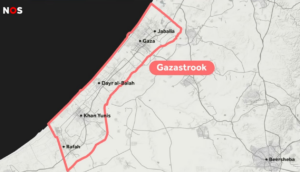
That map did not show the kibbutzim where families had been massacred. Nor did it show the site of the Nova Festival – where nearly four hundred people had been murdered. Nor did it show the town of Sderot, where the Israeli army had fought a full-scale battle with Hamas terrorists, who had also stormed in there, murdering people.
So what did the map actually show? Places in the Gaza Strip where nothing of note had happened on 7 October. Perhaps there had been street parties when hostages were brought in as spoils of war, but this jubilation did not make it into the video. In fact, the hostages did not appear in this video at all. At the time of publication, dozens of children were being held hostage. Their fate was apparently not worth mentioning.
And don’t think that there were other videos that did provide detailed coverage of the suffering in Israel. By the week following 7 October, it was already clear what the trend in subsequent reporting would be. The focus was on the suffering in Gaza, Hamas’s role was downplayed as much as possible, and anything that might have elicited sympathy for Israel was almost entirely left out of the picture.
Omitting relevant information
A key aspect was the systematic omission of Israel’s war aims. Merely reciting endless accounts of war violence without mentioning that Israel was fighting to free the hostages and eliminate Hamas created an image of senseless violence against civilians. Incidentally, these accounts were invariably accompanied by casualty figures provided by Hamas, while Israeli information regarding terrorists killed was omitted.
The suffering of the hostages and their families remained almost entirely out of the spotlight, even as hostages who had suffered terribly returned.
The threat posed by Hamas seemed non-existent, even though countless rockets were fired from Gaza after 7 October, hundreds of Israeli soldiers were killed in Gaza, and Hamas leaders gave interviews in which they vowed to repeat the attacks until Israel no longer existed.
The suffering of the people of Gaza was the main focus, and was attributed solely to Israel’s actions, not to those of Hamas. Furthermore, there was little or no attention paid to all the efforts Israel made to protect the civilian population of Gaza.
Unreliable sources
Much of the information in the video footage comes from unreliable sources, such as Hamas, Al-Jazeera or citizen journalists, who are essentially Hamas propagandists.
In December 2023, the youth news programme presented three propagandists as heroic journalists. Two of the three had, six weeks earlier, demonstrably provided false information about an alleged Israeli bombing of a hospital, which was said to have caused hundreds of deaths. It turned out to be a stray rocket fired by Palestinian terrorists: the hospital was still standing, and the death toll was at most a few dozen. The third ‘journalist’ was also a Hamas propagandist, and there are suspicions that he was involved in the attack in Israel on 7 October.
The NOS team in Israel was well aware of all this. Yet that did not stop the children’s news programme from putting these people in the spotlight. Such dubious characters were frequently given a platform, both in the educational videos and in the children’s news programmes.
Falsehoods
Anyone who uses such sources runs a serious risk of giving falsehoods a platform. But actively spreading demonstrably false information goes a step further. This, too, happened on a large scale. Some falsehoods seemed minor – such as claiming that the Arabs in the region referred to themselves as Palestinians even before 1948 – while others were more significant, and particularly striking because they were repeated so often.
For example, the claim that Israel had completely sealed off the Gaza border before 7 October. The term ‘completely sealed off’ was used in several videos and children’s news programmes. But that border was not completely sealed off at all. The UN keeps records of the flow of people across that border, and every month tens of thousands of Gazans crossed into Israel, and thousands more into Egypt. And yes, there was border control. Not surprising, given all the terror emanating from Gaza. That was the reason why Egypt too – often not mentioned – strictly guarded the border.
In addition to repeated falsehoods, there were also occasional falsities. A UNICEF staff member claimed on a children’s news programme that it was raining ‘constantly’ in Gaza, while the weather forecast showed that, apart from one night-time shower, it had not rained there in weeks. The footage of rain that the NOS had received from UNICEF was from two months earlier.
An even more dubious falsehood: a statement by US President Joe Biden that was edited and subtitled in such a way that it came to mean something entirely different. This was in May 2024, following the indictment of Israel at the International Criminal Court. Biden stated emphatically that Israel is doing everything in its power to protect the civilian population of Gaza, and that there is no question of genocide. The part where he said that, in his view, Israel was not committing genocide was edited out. The section about protecting the civilian population did make it onto the children’s news programme, but with the caption that Israel was protecting its own population, which, of course, completely reversed the meaning of his statement.
This was one of the cases in which we, as authors of the report, could no longer rule out malicious intent.
Misinformation
We certainly did try that. For instance, there was an informational video claiming that the US had supported Israel since 1948 – a claim that, incidentally, was made on several occasions. This is, of course, untrue. There was a global arms embargo that was strictly enforced by the US. American veterans who secretly smuggled weapons to Israel had the FBI hot on their heels. But this claim could, of course, simply be due to ignorance, and thus poor journalism.
Things became more complicated when NOS op 3 followed this up with an excerpt from an interview with former US President Truman as ‘proof’ of this claim. In that excerpt, Truman claimed that the Americans ‘had set up the Israeli government in Palestine and removed some Arabs, after which the Jews had formed a government.’
It took a bit of effort to track down the source of this baffling video, but it turned out to be an interview recorded years later, in which Truman had not been entirely truthful. The NOS editorial team had, in fact, done their research and had come up with this. Was it still possible not to call this a colossal lie?
Yes, with a fair bit of effort, this can be explained without accusing the NOS of lying. An NOS editor who mingles in activist circles may have come across that video online and thought they now had hard evidence that Israel really was a US colonial project. Subsequently, the whole team didn’t question this, didn’t check the facts, and posted it online for Dutch young people. That amounts to poor journalism and, presumably, activism. So, not a deliberate lie. On the other hand, what good does that do for Dutch young people? The result is misinformation.
No incidents
The examples mentioned above are, of course, only a fraction of the total, and each one could be classified as an isolated incident. But that is precisely why we have analysed so much material.
We found no incidents that worked in Israel’s favour, nor any falsehoods or omissions that covered up Israel’s mistakes and harmed the Palestinian cause. This means that we do not find the NPO Ombudsman’s assertion – that there are also complaints that the reporting is too pro-Israel – particularly convincing. Let those complainants come up with examples; we are eager to see them.
Incidentally, all the ‘quality media’ have categorically refused to discuss our report (critically), so no rebuttal of our findings has come from that side either.
A barrage of accusations
Meanwhile, all these media outlets continue down the same path. The most depressing thing is how they manage to produce a ceaseless stream of reports that repeatedly hammer home the message of Israel’s wickedness and the Palestinians’ victimhood.
The flood of accusations makes it almost impossible to verify the claims and, where necessary, refute them. Before the facts of what happened have been properly established, three new stories – often originating from Hamas propagandists – have already been thrown into the mix. A good example of this is the uproar over alleged massacres at food distribution points in Gaza.
On 1 June 2025, media outlets around the world sounded the alarm: Israel was alleged to have killed dozens of Palestinians who were on their way to collect food. The headline on the NOS website read: ‘Dozens of people seeking aid killed in Rafah, Israel denies responsibility’. The entire article assumed Israel was to blame, even though Israel categorically denied this and the story was, in any case, rather strange.
At that time, Israel and Hamas were locked in a battle over food aid. For Hamas, food aid was a means of controlling the population and, moreover, a source of income. A temporary blockade of the aid had already caused Hamas major financial problems, and subsequently an American organisation (GHF) began distributing food aid in collaboration with Israel, thus bypassing Hamas.
The terrorist group protested vehemently, and the UN and many NGOs – which were working with Hamas – condemned the move. When Israel continued to cooperate with GHF, Hamas banned the population from making use of this aid. The terrorist group warned that anyone who disobeyed would ‘pay the price,’ and that Hamas would ‘take measures if necessary.’ In short: it was important to Israel that this project succeed, while Hamas had already announced its intention to sabotage it.
Spreading Hamas propaganda
But as soon as Hamas-controlled sources put out baseless allegations of an Israeli massacre at one such food distribution point, the NOS and the Dutch quality newspapers, defying all logic, went along with this narrative and backed it up with further insinuations.
Apparently, they found it entirely plausible that Israel would shoot itself in the foot in this way, and it did not occur to them that Hamas had every reason to thwart GHF’s efforts. Israel promised an investigation, and that could have restored calm for a while, but it did not. Before Israel had had time to look into the matter, new reports of massacres began to emerge.
For weeks, there were spectacular reports almost every day of mass killings by Israel of Palestinians who had come to collect food aid. When even the Israeli newspaper Haaretz published sensational headlines about the murderous tendencies of IDF soldiers at food distribution points in Gaza, I investigated the matter and wrote an article about it. In that article, I compiled a list of dozens of allegations that the NOS had published in live blogs on this subject, and I cited the sources. All sources were under the control of Hamas or Hamas allies.
Dissenting voices: too few and too late
On a few occasions, the NOS reported that some Palestinian civilians claimed Hamas was firing on people, but those few reports were dwarfed by the countless strident accusations levelled against Israel. For weeks, this dominated the news coverage of Gaza.
Israel subsequently released the findings of its investigation and concluded that there had been a few incidents in which IDF soldiers had shot Palestinians while attempting to maintain order. Fewer than thirty people were killed, and procedures were amended to prevent a recurrence. The media and politicians critical of Israel saw this as an admission by Israel, which would also prove that all reports from Hamas of more than a thousand casualties caused by Israeli fire were accurate.
This is typical of the reporting on the conflict. It is a tactic known as ‘flooding the zone with shit’: making so many serious accusations that your opponent is constantly on the defensive. The sheer volume of accusations will gradually convince the public, while the accused is always lagging behind in refuting them. Hamas can only apply this tactic successfully thanks to the cooperation of the Western media.
Colonna Report
These media outlets have long since ceased to take their own journalistic standards seriously. They publish stories based on unreliable sources and fail to present both sides of the argument. They make no distinction between facts and opinions, and clearly take sides while claiming to be impartial. They do not check their facts, nor do they issue corrections if it later transpires that they have made mistakes. Even when the evidence is overwhelming, they do not correct their mistakes.
A clear example of the latter is the Dutch reporting on the Colonna Report.
This report on UNRWA – the aid agency for Palestinians – was published in April 2024. UNRWA had come under scrutiny because UNRWA staff were alleged to have taken part in the attack of 7 October 2023. Complaints about this went unheeded until the US Congress decided to invite a few organisations with well-founded criticisms. Their testimony in January 2024 caused such a stir that many Western countries immediately suspended their donations to UNRWA.
Two committees were tasked with investigating the issues, and the Colonna Committee was the first to publish a report. This committee had examined UNRWA’s working methods and was highly critical of the shortcomings it had identified. However, the media focused on a single line in the report: Israel had not provided any evidence that UNRWA staff had been involved in the attack on 7 October.
No correction
This was not, however, the subject of the Colonna Commission’s investigation, and therefore not something Israel was required to inform the Commission about. This fell within the remit of a different commission, established by OIOS, an internal UN body. Israel duly provided evidence to the OIOS commission, which published a report in August 2024 concluding that around ten UNRWA staff members had indeed participated in the attack on 7 October.
This OIOS report received virtually no coverage in the Dutch quality media. Nor did the press conference given by Catherine Colonna shortly after the publication of her report receive any attention; in it, she made it very clear that her report did not deal with this matter, and that the OIOS report would provide a definitive answer. Yet in countless Dutch media outlets, the conclusion had already been drawn: UNRWA was not to blame, and Israel had lied.
The depressing thing about this fake news is that it featured prominently in all the ‘quality newspapers’ and was widely reported on the NOS, Nieuwsuur and other programmes. I myself lodged an official complaint about this fake news, amongst other things, only to discover that the so-called oversight of the NPO is a sham. The NPO Ombudsman did not even address the substance of the complaint, and I received no response from the Media Authority either.
Think back for a moment to those Red Line demonstrators: how could they ever have known that UNRWA staff were involved in the atrocities of 7 October 2023?
Powerful media playing the victim
Anyone who considers all this cannot help but become deeply cynical about the reactions from the Dutch media as soon as criticism of the media goes beyond the feeble complaints of individual citizens. Consider the reactions to Deputy Prime Minister Mona Keijzer’s tweet about using information from the Hamas Ministry of Health. Her criticism of the NOS was widely condemned as an ‘attack on the free press’ or even ‘an undermining of democracy’.
The fact that this involved a minister from a small anti-establishment party in a caretaker government was irrelevant. Mona Keijzer was portrayed as someone who abused her power, and the NOS was depicted as a brave counterforce keeping the powers that be in check. The question of whether what Keijzer said was true was not even raised.
The media outlets recommended in all these government campaigns have gained a position of considerable power. They can disregard their own journalistic standards with impunity, yet still retain their reputation for reliability. Anyone who still believes that they are not misleading the public on a massive scale should realise how absurd it was that on 5 October 2025 – after Israel had ratified the ceasefire and Hamas was still refusing to do so – a quarter of a million Dutch people dressed in red demonstrated against Israel’s ‘aggression’. The influence of these media outlets is immense.
Media Motivations
How is it that they choose to campaign so relentlessly against Israel?
It is too simplistic to attribute this immediately to anti-Semitism. Of course, it cannot be ruled out that some journalists are Jew-haters and that they will play a part in fuelling this activism. But the path to anti-Semitism is rarely a direct one. Moral decay usually begins with a slow, almost imperceptible decline. With small steps down a slippery slope.
For instance, it does not seem immoral to go along with fashionable ideologies, such as reducing every conflict to a perpetrator-victim narrative. It becomes somewhat more questionable, however, to further distort reality by applying identity politics to Israel and the Palestinians. The State of Israel – with a sizeable Arab minority and Jews who largely originate from the Islamic world – is then portrayed as the ‘white’ occupier, while the Palestinians – often also descendants of recent immigrants – are the ‘indigenous’ oppressed.
Few journalists seem to realise that they are simply parroting Soviet propaganda. Or perhaps they do realise it, but they agree with it.
Another tendency that seems innocent in itself is seeking to connect with minority groups. After 7 October 2023, many Dutch Muslims took to the streets to protest against Israel, and progressive demonstrators marched alongside them. Progressive journalists had to choose between neutral reporting or aligning themselves with their own social circles.
And this at a time when there is already debate about the need for the media to remain neutral. Anyone following the coverage of the Gaza war will see that journalists are increasingly behaving like opinion-makers. With every step, they move further away from those journalistic codes that were once drawn up by people who understood the weaknesses of human nature.
And even though the combination of all these factors, coupled with peer pressure, is leading to activist journalism that demonises Israel, this does not mean that all these journalists are Jew-haters. But even if the negative reporting does not stem from anti-Semitism, the campaign against Israel is gradually beginning to display all the hallmarks of anti-Semitism.
Old patterns
The bizarre focus on Israel is telling. Comparisons with Sudan or Iran make it clear how easily large numbers of civilian casualties are ignored when the massacres take place elsewhere. No Jews, no news, goes the cynical saying.
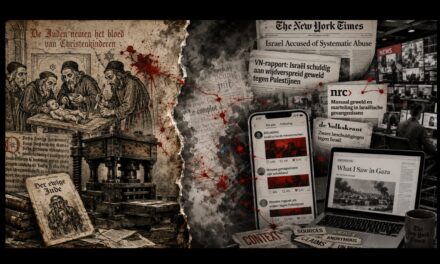
Even more telling is the ease with which lies about Israel are believed and passed on. This is reminiscent of the eagerness of the old accusations against Jews that often led to pogroms. In particular, the countless stories that Israel specifically targets Palestinian children resemble the old blood libels about Jewish murderers of Christian children.
Consider the spectacular front-page article in de Volkskrant – partly copied from the New York Times – in which ample space was given to accusations by activists that IDF snipers were specifically targeting small children. There is not a single factual basis for this story, and de Volkskrant violated its own journalistic standards by failing to investigate the reliability of the activists, by failing to refute the criticism of experts regarding the NYT article, and by not allowing for a rebuttal.
In progressive circles, this is now considered the truth. GroenLinks/PvdA leader Frans Timmermans stood in the House of Representatives waving the Volkskrant article.
Result
The consequences of such reporting are clear.
Long before 2023, Israel’s popularity in the Netherlands began to decline, and since October 2023, the downturn has been dramatic. Opinion polls now show that most Dutch people condemn the Israeli approach in Gaza, and that a large proportion supports sanctions against Israel. Even after the ceasefire of October 2025, the negative image of Israel has not improved. This problem exists throughout the Western world, which is not surprising given that media in other Western countries often follow the same line.
And the negative perception of Israel has more consequences than the growing estrangement between Israel and many Western countries. This perception also affects the Jewish citizens of those countries. Jews are held accountable for Israel’s alleged crimes, and anyone who does not distance themselves from Israel is quickly labelled a Zionist complicit in everything this ‘rogue state’ does. Jews often know better, and are then faced with a dilemma. Do they join in the condemnation of Israel in order to remain socially acceptable themselves? Or do they speak out?
Dutch Jews who refuse to renounce Israel face rejection and exclusion. They lose friends. Some speak out about this, but most withdraw and share their grief and concerns with other Jews at most. They think back to the war stories of their parents and grandparents and wonder how long they can remain in the Netherlands. That is not oversensitivity, but pragmatism.
Taboo on anti-Semitism
We would almost get used to it, but there are countless minor reports of discrimination against Jews and Israelis. And none of that may be called anti-Semitism.
The fact that only Israeli universities are boycotted is not anti-Semitism. No more than the exclusive boycott of Israeli companies, artists, writers, scientists, athletes, tourists, and events. Even a boycott of Dutch Jews does not fall under anti Semitism as long as it is still possible to call it anti-Zionism. And that proves to be possible almost always.
In the Netherlands, we are accustomed to Jewish schools and synagogues needing security. That Jews cannot celebrate Hanukkah without intimidating protesters showing up. That Jewish gatherings must take place in secret locations, and that security is invariably stationed at the door.
When dozens of Israelis were chased and assaulted in Amsterdam in November 2024 while their pursuers euphorically shouted they were going on a Jew hunt, there was a brief moment of shock over this violence. But within a week, the narrative in Dutch media had been reversed: the Maccabi fans were themselves to blame for the violence, and the real victims of this unrest were, after all, the Moroccan Amsterdammers.
In December 2025, the Dutch background programme Medialogica deemed it necessary to dedicate another broadcast to this, which concluded that the Netherlands had been taken in by Israeli propaganda. Medialogica attempted to place as much blame as possible on the Maccabi fans and to downplay the actions of the attackers.
Amsterdam Mayor Femke Halsema participated in this broadcast. That same Mayor Halsema had to come clean shortly afterwards, when a British scandal forced her to tell what had really happened during the Amsterdam persecution of Jews. But do not dare call Femke Halsema antisemitic; she will vehemently reject this accusation.
Thanks to the memory of the Holocaust, a stigma still clings to anti-Semitism, and mere suspicion is regarded as an insult. While barely perceptible ‘micro-aggressions’ already lead to accusations of racism, naming anti-Semitism is more likely to provoke indignation. The term anti-Semitism is increasingly seen as a trick by Israel to deflect criticism, and by Jews to play the ‘victim card’. Gradually, the term is falling into disuse, except for right-wing extremists who give the Hitler salute or openly express their support for the Nazis.
But if violence against Jews is twisted for so long until it is the Jews’ fault, and if criticism of Israel becomes a euphemism for outright demonisation of the Jewish state, is that still not Jew hatred? If anti-Semitism is defined in such a way that nothing is Jew hatred anymore, then anti-Semitism has been normalized. Then it has become the new norm, which merely rejects the old name.
That trendy anti-Zionism that permeates our media reeks of dark times.
You can support Maaike van Charante via repelsteeltje.backme.org
Want to stay up to date with new articles and podcasts? Follow Maaike on Twitter.